
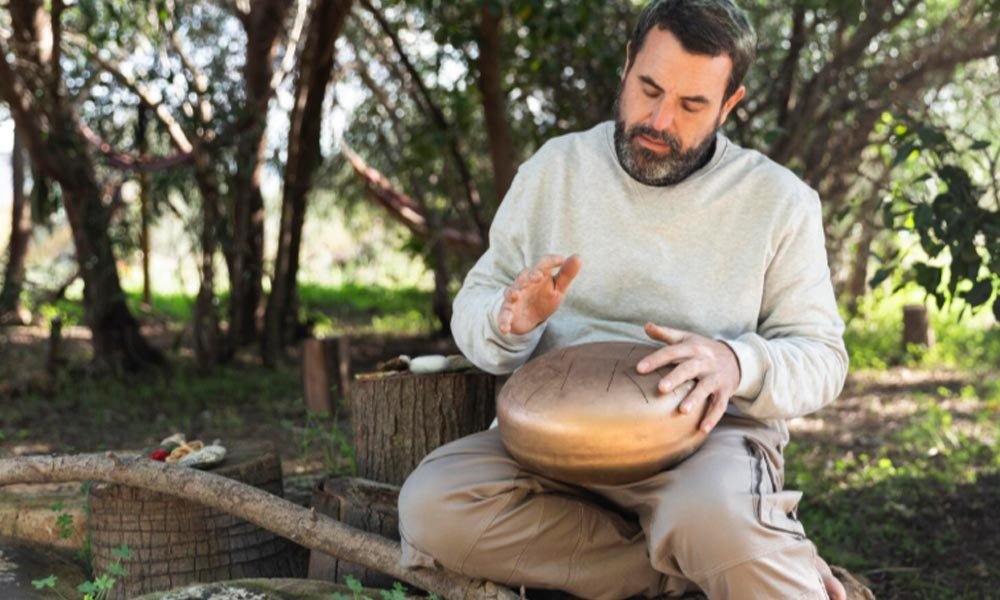
The sound healing benefits that wellness practitioners speak of today are not a recent discovery. Long before neuroscience had the tools to measure brainwave states or map the autonomic nervous system, ancient cultures across the globe understood that sound was far more than auditory experience. It was medicine, ceremony, and a primary technology for altering states of consciousness and restoring inner balance.
In ancient Egypt, temples were constructed with acoustic chambers designed to amplify specific tones during sacred rituals. Tibetan monks developed singing bowl traditions spanning thousands of years, using layered overtones to induce states of deep meditation and physical stillness. Indigenous cultures across the Americas employed drum frequencies in healing ceremonies, understanding intuitively that rhythmic vibration could shift the body’s relationship to pain, fear, and energetic stagnation. These were not primitive guesses. They were refined systems of knowledge passed down through generations of direct experience.
What modern research is beginning to confirm is that these traditions were operating on real physiological and energetic principles, principles that science is only now developing the instruments and frameworks to measure.
What Happens in the Body During Sound Healing
Sound is vibration, and the human body is a vibrational system. Every cell, organ, and tissue maintains its own characteristic frequency pattern, and when those patterns fall into dissonance through stress, illness, emotional trauma, or environmental interference, the body’s capacity for self-regulation is compromised. Sound healing works, in its most basic formulation, by introducing resonant frequencies that interact with the body’s own vibrational field and encourage a return toward coherence.
Research published across multiple scientific journals has documented measurable physiological responses to targeted sound frequencies. Studies involving binaural beats, which are two slightly different tones delivered separately to each ear, have demonstrated consistent reductions in anxiety across populations tested. Vibroacoustic therapy, which delivers low-frequency sound directly through physical surfaces the body rests against, has shown improvements in motor function, pain reduction in fibromyalgia patients, and increased parasympathetic nervous system activity, the branch of the nervous system responsible for rest, repair, and recovery.
The 528 Hz frequency, often referenced in sound healing communities as the love frequency, has drawn attention from researchers exploring its effect on stress hormones and cellular behavior. Similarly, the broader category of solfeggio frequencies, tones rooted in ancient musical scales, has been studied for their potential to influence relaxation, focus, and emotional regulation. While definitive clinical consensus is still forming, the direction of the research consistently points toward one conclusion: sound affects the body in ways that extend well beyond simple mood enhancement.
The Role of the Nervous System
One of the most compelling frameworks for understanding sound healing benefits involves the vagus nerve, the longest cranial nerve in the body and a primary regulator of the parasympathetic nervous system. Tonal vibration, particularly in the lower frequency ranges, appears to stimulate vagal tone, helping shift the nervous system out of sympathetic activation, the fight-or-flight response, and into a state of greater calm and receptivity.
This matters because much of what manifests as physical illness, emotional dysregulation, and cognitive difficulty has roots in chronic nervous system activation. A body that cannot leave a state of stress cannot heal efficiently. Sound, when used with intention and at appropriate frequencies, provides one pathway for creating the neurological conditions in which healing becomes more accessible.
Tibetan singing bowls, crystal bowls, tuning forks, gongs, and the human voice itself are all instruments that practitioners use to deliver these benefits. Each has its own frequency profile, its own resonant character, and its own relationship to specific energy centers and organ systems within the body’s subtle anatomy. The choice of instrument is not arbitrary. In trained hands, it is a precise and intentional selection.
Sound, Consciousness, and Encoded Memory
Beyond the physiological, sound healing benefits extend into dimensions that science is only beginning to articulate. Many traditions hold that certain frequencies do not merely relax the body but can access deeper layers of consciousness, ancestral memory, and encoded information that ordinary waking awareness does not reach.
This is precisely where sound healing intersects with the kind of work being explored by organizations like Artifact Guardians, whose research into ancient crystalline objects and their energetic frequencies suggests that some artifacts may carry vibrational imprints that interact with human consciousness in meaningful ways. The experience of encountering such objects during sound ceremonies or meditative sound immersions has, for many participants, produced states of intuitive recognition, emotional release, and what can only be described as remembering.
Sound has always been understood in esoteric traditions as a carrier of information, not just energy. The idea that specific tones can unlock stored memory, whether personal, ancestral, or encoded within ancient materials, is not new. What is new is the growing context of both neuroscience and consciousness research that makes such possibilities increasingly worth investigating with rigor and open attention.
Bringing Sound Healing Into Practice
For those drawn to explore sound healing benefits personally, entry points are many. Attending a live sound bath or crystal bowl ceremony offers an immediate experiential gateway. Working with a trained sound healer one-on-one allows for more precise frequency application tailored to specific physical or emotional concerns. Personal tools such as tuning forks, handheld singing bowls, or frequency-specific recordings offer a daily practice accessible from home.
The most consistent finding among those who engage with sound healing regularly is cumulative. A single session may produce noticeable relaxation and clarity. Sustained practice over weeks and months tends to produce deeper and more durable shifts in stress response, sleep quality, emotional resilience, and overall wellbeing.
As humanity continues to rediscover what ancient civilizations encoded into their ceremonies, instruments, and sacred objects, sound healing stands as one of the clearest bridges between the wisdom of the past and the healing technologies of an emerging future.
