
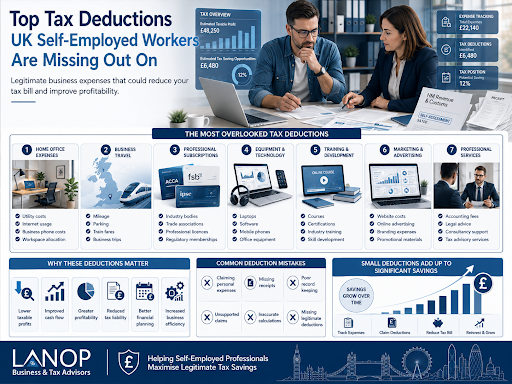
Most self-employed people believe they are claiming everything they are entitled to. The reality, which becomes clear when someone actually sits down and reviews their returns properly, is that a surprising number of sole traders, freelancers, and contractors consistently overpay tax not through negligence, but through genuine gaps in knowledge about what HMRC allows. Many turn to accountants for self-employed professionals precisely at this point, often discovering in the first conversation that they have been leaving money on the table for years. This guide covers the deductions most commonly missed, why they get overlooked, and how to approach your expenses more systematically going forward.
Why So Many Self-Employed Workers Overpay Tax?
The problem is rarely carelessness. It is usually a combination of uncertainty and caution. People stick to the expenses they are confident about and quietly ignore anything they are not sure of. The result is a tax return that is technically correct but not particularly efficient.
Small expenses compound the problem. A £200 software subscription, a £150 professional membership, and £400 in business mileage might each feel too minor to bother tracking carefully. Collectively, across a full tax year, those figures add up to tax relief that simply disappears because nobody recorded them properly.
The signs are usually there: you have never claimed home office costs, you do not track mileage, you rely on memory rather than a system, and your tax return is assembled in a scramble every January. None of that is unusual.it describes the majority of self-employed people in the UK.
Understanding How Tax Deductions Work
HMRC allows expenses that are incurred “wholly and exclusively” for the purposes of the business. That phrase matters. It does not mean the expense has to be used exclusively at work mixed-use expenses can be partially claimed but it does mean the business purpose has to be genuine and documentable.
The two most common errors at this level are overclaiming and underclaiming. Overclaiming putting personal expenses through the business creates HMRC risk and can lead to penalties. Underclaiming the more common problem simply means paying more tax than the law requires. Both are avoidable with the right approach.
The Most Overlooked Tax Deductions
Home Office Expenses
Working from home creates genuine costs, and HMRC allows you to claim a portion of them. The expenses people most consistently forget include electricity, heating, broadband, and in some cases council tax and rent allocation. The broadband bill is the one that gets missed most often people assume it is personal and forget that it serves a business purpose.
HMRC offers two calculation methods: simplified expenses, which provides a flat rate based on the number of hours you work from home each month, and actual costs, which calculates the business proportion of your home expenses based on the number of rooms used for work. Simplified expenses are quicker but often produce a lower figure. Actual costs take more calculation but tend to deliver a better result for anyone working from home consistently.
Business Mileage and Vehicle Costs
If you use a personal vehicle for business travel, visiting clients, attending meetings, travelling to temporary workplaces you can claim mileage at HMRC’s approved rates: 45p per mile for the first 10,000 miles and 25p thereafter. Most self-employed people know this in principle but fail to track it in practice, then find themselves guessing at year-end.
Parking fees, toll charges, and business-related vehicle insurance are also claimable, and they are frequently ignored simply because the receipts feel too small to keep. Over a year, those small receipts represent real money.
Software and Digital Tools
This is perhaps the most consistently overlooked category among freelancers and consultants. Accounting software, CRM systems, project management platforms, cloud storage subscriptions, design tools, and website hosting fees all qualify as allowable business expenses. Most self-employed professionals use several of these monthly. Very few claim all of them.
The reason they get missed is largely psychological; a £12 monthly subscription feels trivial. Twelve of them add up to thousands over a year, and the tax relief on that figure is not trivial at all.
Professional Fees and Financial Services
Accountant fees, bookkeeping costs, payroll support, and tax advisory services are all fully deductible which creates a pleasing circularity, since the cost of getting proper advice reduces the tax bill that proper advice was engaged to reduce. Legal fees directly related to the business are also claimable.
These expenses get overlooked because people assume professional service costs are somehow different from other expenses. They are not. If the cost was incurred for business purposes, it belongs on the return.
Professional Memberships and Subscriptions
| Type of Expense | Claimable? | Notes |
| HMRC-approved professional body memberships | Yes | Must appear on HMRC’s approved list |
| Industry trade association fees | Usually yes | Must be relevant to the business |
| Trade publications and specialist journals | Yes | Business-relevant only |
| General interest magazines | No | Personal, not business |
| LinkedIn Premium | Yes if used for business | Needs to be business-justified |
Industry memberships and trade subscriptions are almost universally missed by self-employed workers who have never had an accountant review their expenses. The rule is straightforward: if the membership or subscription relates to the profession and supports the business, it is allowable.
Marketing and Business Promotion
Website development, hosting fees, SEO services, paid advertising, printed materials, and business cards all qualify. Social media advertising boosted posts, paid campaigns are claimable and frequently forgotten because it gets paid through personal cards without being recorded anywhere useful.
The hidden marketing costs that regularly disappear are the small monthly subscriptions for design tools used to create promotional content, and the domain renewal fees that arrive once a year and get lumped in with personal expenses because nobody set up a system to catch them.
Training and Professional Development
Training is deductible when it updates or improves skills directly relevant to the existing business. A copywriter attending an advanced writing course qualifies. A copywriter attending a cooking class does not, regardless of how personally enriching it might be.
HMRC’s position is that training costs are allowable when they maintain or improve skills needed for the current profession, but not when they represent entry into a new field entirely. In practice, this means most professional development costs for existing freelancers and consultants are claimable and most go unclaimed.
Equipment and Office Purchases
Laptops, monitors, specialist tools, office furniture, and safety equipment all qualify for relief, either as immediate expenses or through capital allowances depending on how they are treated. The Annual Investment Allowance allows most small businesses to claim the full cost of qualifying equipment in the year of purchase rather than spreading it over years.
The items that fall through the gap most often are mid-range purchases: a £600 monitor, a £400 chair, a £300 headset for remote calls. Each one feels like a borderline case. None of them actually are.
Mixed-Use Expenses: The Area That Causes Most Confusion
Mobile phones, broadband, vehicles, and home office costs all fall into the mixed-use category used partly for business, partly for personal purposes. HMRC does not require these to be exclusively business. It requires the business portion to be calculated reasonably and documented properly.
For a mobile phone used roughly 70 percent for business, 70 percent of the contract cost is claimable. The same principle applies to broadband. The calculation does not need to be precise to the decimal, but it does need to be defensible if HMRC ever asks.
Expenses HMRC Commonly Rejects
Understanding what does not qualify is as useful as knowing what does.
| Expense Type | Why Is It Rejected? |
| Everyday clothing | Must be a uniform or specialist protective gear |
| Personal travel | Commuting to a regular workplace is not claimable |
| Family meals | Personal expenditure regardless of context |
| Entertainment | Client entertainment is specifically disallowed |
| Personal fines | Not allowable under any circumstances |
| Home improvement costs | Not claimable even if you work from home |
The category that trips people up most consistently is entertainment. Unlike some other countries, HMRC does not allow client entertainment as a deductible expense. A working lunch attended only by yourself, recorded as subsistence while travelling for business, is different but a dinner with a client is not claimable regardless of how business-focused the conversation was.
Common Tax Deduction Myths
You need a receipt for every expense. Not strictly true, though records of some kind are required. Bank statements, digital records, and invoices can serve the same purpose as physical receipts in many cases. The goal is to have documentation that supports the claim the specific format is less rigid than most people assume.
Claiming home office expenses triggers an investigation. This myth has persisted for years and is simply not true. Home office claims are routine. HMRC does not single out businesses that claim legitimate home working expenses.
You can claim every meal you buy. Subsistence food and drink while working away from your base is claimable in certain circumstances. Every meal, every day, regardless of context, is not.
It is too late to claim missed expenses. You can amend a self-assessment tax return up to twelve months after the original filing deadline. For the 2022-23 tax year, that means amendments could be made until 31 January 2025. Overpaid tax from missed deductions can be recovered but only if you act within the time limit.
What If You Forgot to Claim Expenses?
Amending a previous return is straightforward through your HMRC online account. The process allows you to add missed expenses, recalculate the tax owed, and recover any overpayment. You will need the original records receipts, invoices, bank statements to support the amended figures.
The time limit is twelve months from the original filing deadline. After that, the return is fixed. This makes the case for reviewing past returns promptly rather than assuming the window has already closed.
A Self-Employed Expense Checklist
Before submitting your next return, work through this list and ask honestly whether each category has been considered and documented:
- Home office costs (electricity, heating, broadband, rent proportion)
- Business mileage and associated vehicle costs
- Mobile phone business proportion
- Software subscriptions and digital tools
- Accountant and professional advisory fees
- Professional memberships and trade subscriptions
- Marketing, advertising, and website costs
- Business insurance premiums
- Training and CPD relevant to the current business
- Banking charges and merchant fees
- Equipment, tools, and office purchases
When Professional Tax Support Becomes Valuable?
There is a point at which the complexity of managing self-employment tax outpaces what most people can reasonably handle alone particularly when income grows, when multiple income streams emerge, or when the Making Tax Digital requirements add another layer of record-keeping obligation.
Working with accountants for self-employed individuals at that stage is not an admission of defeat. It is a recognition that the cost of professional support is generally lower than the cost of continued overpayment and compounding errors. The first proper review of a self-employed tax position almost always surfaces something: a missed category, a miscalculation, an unclaimed relief that more than covers the advisory fee.
Frequently Asked Questions
I only use a spare room part of the time for work. Can I still claim home office expenses?
Yes. You do not need a dedicated office. HMRC allows a proportion of household costs based on reasonable business use. Calculate based on the number of rooms and hours used for work, or use the simplified flat rate if the calculation feels complex though the flat rate often produces a lower figure than working out actual costs properly.
My laptop is used for both work and personal use. Can I claim the full cost?
Only the business proportion. Estimate the percentage of genuinely business-related use and claim that portion of the purchase price. If the laptop is used 80 percent for client work, 80 percent of the cost is claimable. The estimate needs to be reasonable and defensible. Claiming 100 percent of a device with clear personal use is one of the errors HMRC picks up on most consistently.
I have never claimed software subscriptions. Can I go back and add them to previous returns?
Yes, within limits. You can amend a self-assessment return up to twelve months after the original filing deadline. If missed subscriptions fall within an amendable year, you can add them, recalculate the tax, and recover the overpayment. Beyond that window the return is fixed which is why reviewing past returns promptly matters more than most people realise.
I attended a course to learn a new skill I now use in my business. Is that claimable?
It depends. Training is allowable when it updates or improves skills already used in the existing business. It is not allowable when it represents entry into an entirely new field, even if that field later becomes part of how you earn. A developer learning a new coding language qualifies. A copywriter learning bookkeeping to start offering a new service likely does not.
Is my accountant’s fee itself a deductible expense?
Yes, and it is frequently overlooked. Fees paid to an accountant, bookkeeper, or tax advisor for business-related work are fully allowable expenses including the cost of preparing your self-assessment return and any tax planning advice. The result is that the cost of professional support directly reduces the tax bill it was brought in to manage.
Conclusion
Missing legitimate deductions is one of the most consistent and correctable ways self-employed workers pay more tax than necessary. The expenses covered in this guide are standard allowances HMRC makes available to every sole trader, freelancer, and contractor not obscure reliefs or aggressive strategies.
Lanop Business and Tax Advisors works with self-employed professionals across the UK to identify missed deductions, recover overpaid tax where amendment windows are still open, and build year-round record-keeping habits that ensure nothing gets missed going forward.
Reviewing expenses properly and understanding the rules around mixed-use costs puts you in a significantly stronger position. With Lanop Business and Tax Advisors alongside you, that review does not have to happen alone.