
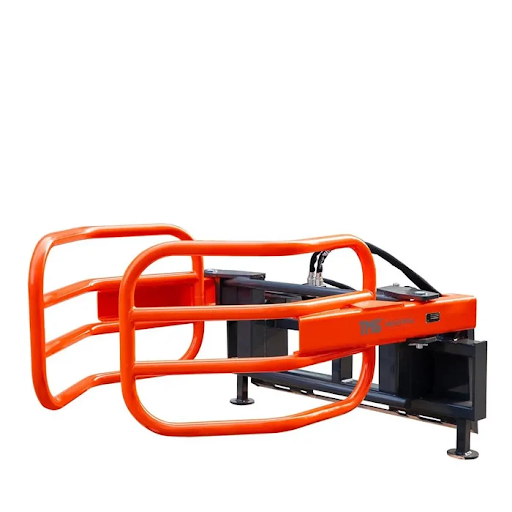
Haying ends with a stack that has to last until spring
The rush of a Canadian haying season ends the moment the last round bale leaves the field, and what follows matters just as much. Those bales have to be stacked somewhere they will keep, and then taken back out one at a time through a long winter, which is where a bale gripper does most of its real work.
Owners tend to judge a bale gripper on how quickly it clears a field, which is the easy half of the job. The harder half is the six months afterward, when bales are being pulled from a stack in poor weather and fed out in the cold.
Where the stack sits decides how much hay survives
Hay stored on bare, low ground wicks moisture up from the soil and spoils along its bottom edge, and that loss is invisible until the bale is opened months later. Choosing well-drained, slightly raised ground costs nothing at stacking time and saves a meaningful share of the crop. Gravel, old pallets, or a bed of coarse rock under the bottom row all break that contact with wet ground.
How the rows are laid out is a weather decision
Dry hay stacked outdoors keeps best in single rows running north to south, spaced apart so wind and sun reach the sides and dry them after every rain. A bale gripper makes those spaced rows practical, because each bale is placed exactly where it is meant to go rather than rolled into whatever position it lands in. Packing bales tightly side by side is what traps moisture between them.
Wrapped bales change the rules completely
Silage and haylage are wrapped to keep air out, and the whole preservation depends on that plastic staying sealed. A single puncture lets air in, and spoilage spreads from the hole through the bale. This is where a bale gripper earns its place over a spear. Clamping a wrapped bale from the outside keeps the film intact, while driving a spike through the middle of one guarantees the very breach the wrap exists to prevent.
The stack has to come apart in the order it went up
A stack built without thought becomes a problem in February, when the bale that is needed sits at the back of a pile with a meter of snow packed around it. Building with access in mind means leaving a working lane, keeping the oldest hay where it can be reached first, and stacking no higher than the loader can safely take down on frozen, uneven ground.
Stacking height is limited by the ground, not the loader
It is tempting to build high and save yard space, but a stack is only as safe as the ground beneath it, and hay yards are rarely level or firm after a wet autumn. Bales settle unevenly as the bottom row compresses, and a tall stack on soft ground can lean and shed a bale without warning. Two or three high on prepared ground is the usual working compromise.
Winter feeding is where the attachment is used most
Through the feeding months the routine repeats daily. One bale is lifted from the stack, carried to the ring or the feeder, and set down, often in wind and poor light with cattle already waiting. A grazier near Brandon lays his winter rows so the tractor never has to reverse into deep snow, which is a decision made in August that pays back every single day of January.
The stacking habits that protect a season of hay
- Raise the base: keep bales off wet ground
- Space the rows: let wind dry the sides
- Clamp wrapped bales: never spear the film
- Leave a lane: plan winter access first
Where a gripper wins and where a spear still serves
- Strength: handles wrapped bales without puncturing
- Strength: places bales precisely when stacking
- Limit: a heavier attachment than a simple spear
- Limit: reach out front asks for a steady machine
Weighed against a spear, a bale gripper costs more and demands hydraulic flow from the machine, and it returns both the wrapped bales it can carry safely and the stack that is still workable when the snow is deep. On an operation feeding wrapped bales through winter, that difference decides the purchase outright.
Feed losses are being counted more carefully every year
As feed costs climb, producers increasingly measure what spoils in the stack rather than only what comes off the field, and handling equipment gets chosen for how it protects the crop through storage. Storage losses are invisible at stacking time and painfully obvious when a bale is opened in March.
That closer accounting is why the farm attachments that TMG Industrial supplies are built around holding a bale rather than piercing it.