
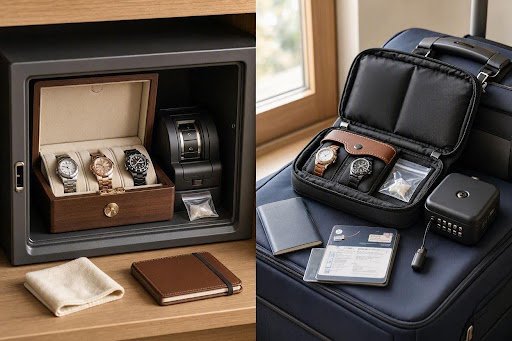
A luxury watch deserves more than a safe place to sit when you are not wearing it. Proper storage helps reduce scratches, keeps straps in better condition and makes it easier to care for a growing collection.
This becomes especially important when you own several mechanical watches. A piece that looks perfect on the wrist can quickly pick up marks if it is left loose in a drawer with other watches, keys or accessories.
The good news is that protecting your watches does not have to be complicated. The right storage method depends mainly on how many watches you own, how often you wear them and whether you need a solution for home or travel.
Here is how to choose a practical storage setup while keeping your collection organised and ready to wear.
Why Proper Watch Storage Matters
Luxury watches are designed for regular use, but they still benefit from sensible storage. Metal cases and bracelets can rub against each other, while leather straps can suffer if they are kept somewhere damp or exposed to excessive heat.
A good storage solution should provide three things: protection, organisation and easy access.
Instead of leaving watches loose on a bedside table, consider a dedicated watch box or roll with individual spaces. This simple change can help prevent unnecessary contact between pieces.
Your storage location matters too. A cool, dry and stable environment is generally preferable to a windowsill, bathroom or area exposed to direct sunlight.
For Rolex owners, the manufacturer’s own care guidance recommends regular gentle cleaning and explains that mechanical watches can continue running through the movement of the wearer’s wrist.
Watch Boxes for Everyday Home Storage
If you have several watches and regularly rotate between them, a watch box is one of the most convenient options.
A quality box gives every watch its own compartment, reducing the chance of cases or bracelets touching. It also allows you to see your collection at a glance when deciding what to wear.
Look for features such as:
- Soft, protective watch cushions
- Separate compartments
- A secure lid
- Strong construction
- Enough room for your current collection
- Additional space if you expect to buy more watches
A watch box can also make your morning routine easier. Instead of searching through drawers, you can keep your favourite pieces together and ready to use.
For a larger collection, it may make sense to separate everyday watches from pieces worn only occasionally. This reduces unnecessary handling and keeps less frequently worn watches safely stored.
Why Watch Rolls Are Useful for Travel
A watch box works well at home, but it is not always practical when travelling.
This is where a watch roll can be particularly useful. It is compact, easy to pack and designed to keep individual watches separated while you are on the move.
If you regularly travel with two or three watches, a dedicated quality leather watch rolls range can provide a more organised alternative to putting watches loose inside a suitcase.
Leather is also a popular choice because it offers a classic appearance that suits traditional mechanical watches. However, the most important consideration is not simply how attractive the roll looks. The interior should provide enough padding and separation to reduce contact between watches.
What to Look for in a Travel Watch Roll
Before buying one, consider:
- Number of watches: Choose a size that matches your normal travel needs.
- Interior protection: Soft surfaces help reduce the risk of unwanted marks.
- Secure closure: The watches should remain firmly inside during transport.
- Compact design: A roll should not take up excessive luggage space.
- Build quality: Stitching, fasteners and materials should be suitable for regular use.
A roll is particularly handy when you want to take a small selection from a larger collection rather than your entire watch box.
Should You Use a Watch Winder?
Watch winders are often discussed among automatic watch owners, but they are not automatically necessary for every collection.
An automatic mechanical watch winds as its movement receives energy from the wearer’s motion. When it is left unworn, it will eventually stop once its available power has been used.
That does not mean every automatic watch needs to remain on a winder.
For some owners, the convenience is the main attraction. A watch winder can keep a compatible automatic watch running while it is off the wrist, which may save time when the watch has a complicated date or other setting.
For example, Rolex explains that its Perpetual rotor uses wrist movement to transfer energy to the mainspring. Rolex also states that a watch left unworn can retain its charge for a period that varies by model.
If you are considering whether a winder makes sense for a particular watch, check the manufacturer’s instructions rather than assuming every automatic movement should be kept running.
For collectors interested in the subject, our range of perfect rolex watch winder provides another useful starting point for understanding the role of winders in a luxury watch collection.
How to Store a Rolex When You Are Not Wearing It
A Rolex does not need complicated daily treatment, but sensible storage is still worthwhile.
Start by choosing a clean, dry location away from unnecessary heat and direct sunlight. Keep the watch in a dedicated compartment or protective case rather than allowing it to move around with other objects.
If your watch has a metal bracelet, make sure it is positioned so that it does not constantly rub against another watch. Leather straps need extra consideration because moisture and poor ventilation can affect them over time.
Cleaning should also be gentle. Rolex recommends using a microfibre cloth to help preserve the watch’s lustre and gives specific guidance on cleaning its cases and bracelets.
For more detailed care information, the official Rolex watch care and service guidance is a useful authority to consult.
Keep Your Watch Collection Away From Unnecessary Risks
Good storage is not only about preventing scratches. The surrounding environment matters too.
Avoid storing valuable watches:
- In direct sunlight
- Near radiators or strong heat sources
- In very humid areas
- Loose inside luggage
- In a drawer with keys or metal objects
- Where children or pets can easily knock them over
A bedroom drawer may seem convenient, but a dedicated storage case gives you considerably more control over how each watch is positioned.
For especially valuable collections, consider whether your home security arrangements are appropriate. A quality watch box can organise and protect the watches, but it should not be treated as a substitute for proper security.
Choosing Storage Based on Your Lifestyle
There is no single perfect storage solution for every collector.
If you own one or two watches and rarely travel, a compact watch box may be all you need.
If you have several watches and change them frequently, a larger display box makes more sense. It keeps everything visible while giving each watch its own space.
If you travel often, a watch roll can be the better choice because it takes up less room.
And if you own several automatic watches with complications that you prefer to keep ready to wear, a suitable watch winder may add convenience.
The best approach is to build your storage around your actual habits rather than buying the most complicated option available.
A Simple Storage Routine for Watch Owners
You can make watch care easier by following a simple routine.
Before putting a watch away, give the case and bracelet a quick visual check. If there are fingerprints or light surface marks, use an appropriate soft cloth.
Then place the watch in its own compartment. Avoid stacking watches on top of one another.
For travel, make sure the watch is secured inside its roll before placing the roll in your luggage. Avoid packing it alongside hard objects that could press against the case.
Finally, follow the manufacturer’s instructions for winding, cleaning and servicing. Rolex, for example, recommends periodic professional servicing and currently advises approximately every 10 years depending on the model and real-world use.
Frequently Asked Questions
- What is the best way to store a luxury watch?
Keep it in a clean, dry and stable environment inside a dedicated watch box, case or roll. Give each watch its own space to reduce contact and scratches. - Are leather watch rolls good for travel?
Yes. They are compact and can keep several watches separated during a trip. Choose one with suitable padding and secure closures. - Does every automatic watch need a watch winder?
No. A winder is mainly a convenience for owners who want a compatible automatic watch to remain running while it is off the wrist. Follow the watch manufacturer’s guidance. - Can I store multiple watches together?
You can store them in the same box, but each watch should ideally have its own compartment or cushion. Avoid allowing cases and bracelets to rub against each other. - Where should I avoid storing my watch?
Avoid areas with excessive heat, direct sunlight or high humidity. Also avoid loose storage alongside keys, coins and other hard objects. - Should I keep my Rolex in its original box?
The original box can be useful for long-term keeping, but a dedicated everyday storage solution may be more convenient if you frequently wear and rotate your watches. - How often should a Rolex be serviced?
Rolex currently recommends professional servicing approximately every 10 years, depending on the model and how it is used.
Final Thoughts
Luxury watch ownership is about more than choosing a beautiful timepiece. Good storage is part of responsible ownership, especially when your collection includes valuable mechanical watches.
For everyday use, a well-organised watch box offers convenience and protection. For travel, a quality watch roll keeps your pieces compact and separated. A watch winder can provide additional convenience for certain automatic watches, but it should be chosen according to the movement and your personal needs.
Most importantly, keep your watches away from unnecessary environmental risks, handle them carefully and follow the manufacturer’s care recommendations. A few simple habits can make your collection easier to enjoy while helping each timepiece stay in good condition for years to come.