
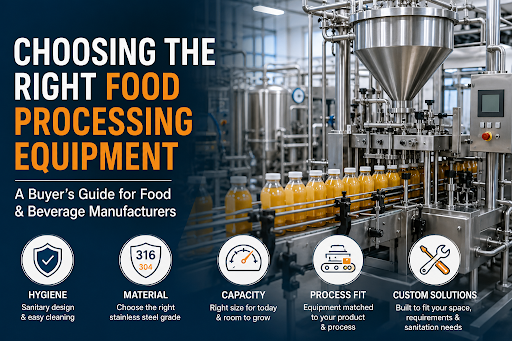
Choosing the Right Food Processing Industry Equipment: A Buyer’s Guide for Food and Beverage Manufacturers
Replacing outdated machinery isn’t just a price comparison. Neither is adding a new line. What you land on shapes hygiene, product consistency, how smoothly production runs, how much maintenance it needs, and what you’ll be paying to keep it going for years.
Food and beverage manufacturers carry an extra layer on top of that. Your equipment has to work with the facility’s sanitation programme, not against it. Canadian food safety guidance expects food processing industry equipment to stay accessible for cleaning, inspection, maintenance, and sanitation, and built from materials that are suitable, durable, cleanable, and non-corrosive.
Where do you start, then? Not the catalogue. Start with the production process. Material selection, capacity, fabrication choices, they all affect how equipment performs over its working life, and sorting these out early saves you a headache down the road.
Key Factors When Selecting Food Processing Equipment
Good equipment selection starts with the product, the process, how it gets cleaned, the space you’ve got, and the volume you actually need to hit. The catalogue comes after that.
Is the Equipment Designed for Hygiene?
Sanitary design cuts contamination risk and makes cleaning easier. Food-contact surfaces need to be smooth, accessible, durable, and non-absorbent. No pits. No cracks or crevices. No ledges or dead zones where residue can quietly collect.
Drainage matters too, and so does sanitation more broadly. Enclosed equipment might call for a clean-in-place system. Removable parts should come apart easily enough to clean and inspect by hand.
Here’s an assumption worth pushing back on. Not every stainless-steel machine automatically checks every sanitary box. NSF standards cover material safety, design, construction, and performance, and different equipment categories fall under different standards. Confirm which ones apply before you buy.
Which Stainless Steel Grade Should You Choose?
Stainless steel holds up well in demanding production environments. It’s durable, easy to clean, and resists corrosion. That said, picking a grade isn’t a one-size-fits-all exercise.
304 handles a lot of general applications just fine. 316 or 316L pull ahead where corrosion exposure runs higher. A lot rides on specifics like product acidity, salt content, moisture, temperature, and whatever cleaning chemicals are in rotation.
And the grade alone won’t save you. Surface finish and fabrication quality matter just as much. Sloppy welds, joints that are hard to clean, surfaces you can’t reach, a design that leaves somewhere for residue to hide, any of these can undercut even the right material choice.
How Much Capacity Does the Process Need?
Base capacity on what you’re producing, not an optimistic forecast. That means weighing current production volume, peak demand, batch size, cycle time, required line speed, available floor space, utility requirements, and where you expect growth to take you.
Go too big, and costs climb without much payoff. Go too small, and you’re back in the market sooner than planned.
Scalable equipment splits the difference: room to grow, without sacrificing today’s efficiency.
Food Processing vs. Food & Beverage Processing Equipment: Key Differences
These terms get used interchangeably a lot, but requirements can differ quite a bit depending on what’s being produced.
| Consideration | Food Processing Equipment | Food & Beverage Processing Equipment |
| Product characteristics | Solids, powders, semi-solids, or mixed products | Liquids, beverages, emulsions, and fluid products |
| Common functions | Mixing, conveying, cutting, forming, cooking, handling | Blending, pumping, heating, cooling, filling, filtration |
| Sanitation needs | Cleanable surfaces and contamination control | Sanitary transfer, tanks, valves, piping, and cleaning |
| Material considerations | Product, moisture, heat, and cleaning environment | Acidity, corrosion, temperature, and fluid characteristics |
| Main design priorities | Product handling, access, throughput, cleaning | Flow control, transfer efficiency, temperature, cleaning |
These categories still spread into each other in practice. The better move is to choose the food processing equipment industry based on your actual product, your production sequence, how you sanitize, your facility layout, and the capacity you need, rather than the label on the equipment.
That equipment takes plenty of forms: blenders, mixers, conveyors, tanks, kettles, lifts, platforms, enclosures, panels, hoppers, receiving and discharge stations. Which combination fits comes down to how ingredients move through the process.
Working With a Custom Fabricator: What to Expect
Standard machinery doesn’t always fit an existing production environment. Tight floor space. Unusual batch sizes. Specific discharge requirements. Equipment already in place that everything else has to work around. Specialised sanitation procedures. Any one of these can push a manufacturer toward custom equipment instead.
Start With the Production Requirements
A capable fabricator wants to understand the application before recommending anything. That means being ready to talk through product characteristics, batch sizes, production targets, operating temperatures, material requirements, cleaning, sanitation procedures, available floor space, existing equipment, connection points, utilities, operator access and safety requirements.
The more detail that goes into that conversation, the clearer a picture the fabricator has of what the equipment actually needs to do.
Expect More Than a Fabricated Machine
A typical project moves through several stages. Requirement review and process assessment usually comes first, followed by a preliminary concept, dimensions, material, design selection, engineering, fabrication, finishing, quality checks, installation or integration where needed, and finally testing, adjustments, and documentation.
Quality assurance runs through all of that, start to finish. Fabrication needs to support the actual application, and the finished equipment should match the sanitation and operational requirements set during design.
Considering custom fabrication for food processing? Keep the goal simple: build the food processing industry equipment around the process, not the other way around.
Why Can Custom Design Make Sense?
A custom approach can mean better use of floor space, easier integration with what’s already running, equipment built around a specific workflow, better access for cleaning and maintenance, more flexibility for unusual capacity needs, and room for future modifications.
But custom isn’t automatically better. It makes sense when the design solves a real problem, space, sanitation, production, integration, not just because it sounds impressive on paper.
Questions to Ask Your Equipment Fabricator
A thorough conversation before fabrication starts can prevent expensive changes later. These are worth running through before signing off on any design.
What material grade fits my application?
This should factor in the product, cleaning chemicals, temperature, moisture, and corrosion exposure. Push for the reasoning behind a recommendation rather than accepting a generic answer.
Which sanitary standards apply?
NSF, 3-A, or other requirements can all come into play, and certification depends on the equipment category. One designation doesn’t automatically cover everything.
How will the equipment be cleaned?
Manual cleaning, washdown procedures, and clean-in-place systems, whichever applies, need to be discussed upfront. Canadian guidance is direct on this: food processing industry equipment has to support effective cleaning and sanitation while keeping contamination out.
Can it handle future production growth?
Higher volumes, added components, modular changes, and upgrades, the design should leave room for some of this. It’s really about protecting today’s investment against tomorrow’s production needs.
What maintenance will it require?
Ask about wear components, access points, inspection areas, replacement parts, lubrication, and routine servicing. If technicians can’t get to something easily, a routine maintenance job turns into costly downtime fast.
What documentation comes with it?
Drawings, material information, specifications, operating instructions, maintenance details, compliance or certification paperwork, request it all. Good documentation also means future technicians aren’t starting from zero.
How will it integrate with existing equipment?
Dimensions, utilities, controls, conveyors, piping, electrical requirements, discharge points, and operator access, confirm these ahead of time. Integration problems have a way of undoing an otherwise well-built machine.
Choose Equipment Around the Process
The lowest price tag doesn’t always mean the lowest total cost. Moreover, the fanciest machine on the market isn’t necessarily right for a given floor.
The right food processing industry equipment balances hygiene, durability, throughput, maintainability, safety, integration, and where things are headed next. Canadian food safety guidance backs this up too, pointing to equipment that stays suited to its intended process and supports real sanitation and contamination control.
For food and beverage manufacturers, the strongest buying decisions start with a clear specification. Product, process, capacity, available space, cleaning method, materials, maintenance needs, and integration requirements, nail these down before a quote ever enters the picture.
When standard machinery can’t meet those requirements, an experienced fabricator can help turn a production process into something that actually works.
FAQs
What makes food equipment truly sanitary?
Smooth, accessible surfaces. Suitable materials. Drainage. Minimal spots for contamination to hide. Beyond that, it comes down to the product, the process, the cleaning method, and whatever standards apply to that particular piece of equipment.
How should equipment capacity be calculated?
Production volumes, peak demand, batch sizes, cycle times, available operating hours, expected growth, start there. A realistic read on capacity keeps equipment from capping output or costing more than necessary.
Is stainless steel always the best choice?
Not automatically, though it’s usually a strong fit. The right grade still depends on the product, cleaning chemicals, temperature, moisture, and corrosion exposure. A fabricator can point toward what suits the process at hand.
When should manufacturers consider custom fabrication?
When standard equipment can’t fit the available space, the workflow, the product requirements, the capacity targets, or the existing machinery. Unusual integration or sanitation challenges tend to push things this direction too.
What should food processing industry equipment include?
It depends entirely on the production process. Hygienic design, suitable materials, throughput, cleanability, maintenance access, safety, integration, and future production needs all deserve a seat at the table.