
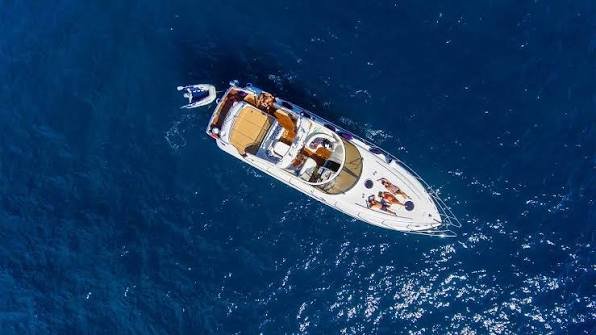
On most coastal resorts, the underwater world reveals itself gradually. First a sun-warmed shallow, then a gentle slope, and only after a few hundred metres does the water turn genuinely oceanic. Madeira works differently, and that difference explains almost everything else about it.
The island isn’t a landmass ringed by a continental shelf — it’s the summit of a single shield volcano rising nearly six kilometres from the floor of the Atlantic. Madeira has no broad continental shelf of the kind found off most mainland coasts: the terrain around the island is dominated by a steep volcanic slope, which means real depth starts noticeably closer to shore than it does at most resorts built on the mainland. The seabed around the archipelago stays complex and deep even between the neighbouring islands — a reminder that Madeira’s character is oceanic, not shelf-bound.
That’s not a line from a tourist brochure. It’s a geological fact that shapes almost everything else: which fish live here, which animals pass close to the island, why the light on the water looks different than it does on flat sandy coasts, and even which route actually makes sense for a boat to take. Here’s how each of those plays out.
Whale and Dolphin Watching: Why the Seabed Makes All the Difference
The first thing this affects is who you’re likely to meet at sea. Large marine mammals — sperm whales, pilot whales, several dolphin species, and migrating whales among them — need depth to hunt and to move along their usual routes. Where the water shallows gradually, those routes lie far offshore, and reaching them can take hours. Off Madeira, deep water starts noticeably closer to the coast than at most resorts, so animals that elsewhere take half a day to find are often within a short boat ride. Madeira is considered one of Europe’s strongest destinations for cetacean sightings: encounters happen across different seasons, though the species and the odds depend on the time of year, the weather, and the route.
That’s why a standard boat trip in Madeira waters along the coastline isn’t really a beach cruise — it’s closer to a short expedition into open ocean, with a meaningfully better chance than most resorts offer of meeting something large and wild. The difference from most whale-watching destinations comes down to logistics: elsewhere, it’s a separate, pre-planned full-day outing with a long transit out and back. Off Madeira, the deep water sits close enough that a dolphin or whale sighting often folds into an ordinary coastal outing, without needing a dedicated “whale tour.”
There’s a second, less-often-mentioned effect: several cetacean migration routes pass near Madeira, and the sharp drop-off in depth means the water, under the right conditions, stays clear even a couple of hundred metres from shore. That means animals aren’t always just spotted on the horizon — in good weather, they’re sometimes visible just beneath the surface, a rarity even in regions that specialise in whale watching. Captains running that standard coastal route typically work off recent sighting data rather than a fixed line on the chart — it’s the nearby depth that lets them adjust course on the fly.
Fishing and Spearfishing: How Depth Changes the Way You Go to Sea
The second consequence of the same geology is a completely different style of fishing. In shallow water, fish tend to be smaller and have to be coaxed out with bait, timing, and detailed knowledge of the seabed over a wide area. Along a steep, drop-off coastline, large pelagic fish — tuna, amberjack, barracuda — come in close to the cliffs, because the depth itself acts as a natural feeding zone: cold currents pull nutrients up from below, and predators follow the baitfish right to the shoreline.
That’s also why spearfishing is such a strong tradition on Madeira, alongside classic trolling. Spearfishing needs two things at once: good visibility and reachable depth where the big fish actually hold. Those two conditions usually pull against each other — either the water is clear but shallow and thin on large fish, or it’s deep but the transit there turns the whole outing into a full-day logistics exercise. Off Madeira, both conditions often line up within a short run from the marina: a cold current rising along the volcanic slope brings clear water and a feeding ground for predatory fish at the same time.
In most parts of the world, spearfishing with fins and a speargun is only possible at a handful of specific spots after a long transit; here it’s often just part of an ordinary day on the water rather than a separate expedition. The same logic applies to conventional sea fishing: trolling for tuna or amberjack frequently doesn’t require heading out of sight of land, because the fish themselves stay close to shore. The island’s geography makes it possible to combine classic ocean fishing and spearfishing in Madeira into a single outing — distances that elsewhere would split these two formats across different routes and different days often fit into a few hours here.
One important caveat: spearfishing isn’t a “just grab a mask and go” activity. It requires training, the right gear, and a licence. Beginners are given a particularly conservative route and depth, and heading out alone in the open Atlantic without experience or supervision isn’t something to attempt — the nearby deep water simplifies the day’s logistics, but it doesn’t waive the safety rules of open-water diving. Getting licensed, at least, isn’t a hassle: it can typically be arranged online in a few minutes, or just as quickly through the relevant local office, for a modest fee — so the paperwork doesn’t end up being the obstacle for anyone who’s already decided to try it.
Cliffs That Don’t Recede, Even at Sunset
The third thing this steep underwater terrain gives you is how the island looks from the water at the end of the day. Where a coastline shelves gently, a boat at sunset sits far from land, and the island flattens into a line on the horizon. Off Madeira, it’s the opposite: because the depth lets a boat come right up against the coastal cliffs without any risk of running aground, a sunset route can hug the shoreline itself — right where basalt cliffs, shaped by the same volcanic processes, rise hundreds of metres straight out of the water. The sun doesn’t set into flat water; it sets behind real, three-dimensional terrain, and that changes the whole experience — the light lands on the rock in layers instead of simply fading into the horizon.
This is a case where a beautiful sunset isn’t a marketing cliché but a direct consequence of the island’s geology. At most seaside resorts, the sunset route amounts to idling in open water: the boat cuts the engine at a safe distance from shore and waits for the sun to sink into the horizon. Off Madeira, the sunset route is movement along the coast, because the closeness of deep water to the cliffs allows the boat to stay near land without risk. The view shifts every few minutes: the light moves from one rock face to the next, shadows lengthen across cliffs hundreds of metres high — this isn’t a static postcard, it’s a route with its own unfolding drama.
That’s exactly why an evening sunset boat trip in Madeira is usually planned to stay along the stretches of coast where the terrain allows a close, safe approach to the cliffs — precisely where the effect is strongest, not wherever happens to be most convenient to moor.
What to Know Before a Boat Trip on Madeira
The closeness of deep water is an advantage, but it also calls for a slightly different approach to planning a day at sea than you’d use on a gently sloping coast.
- The weather window matters more than usual. Without a shallow buffer zone, wind and swell are felt more sharply, so experienced operators plan the route around the specific day rather than running a fixed itinerary regardless of conditions.
- The boat needs to be built for this kind of water. A light pleasure boat suited to a sheltered bay and a vessel meant for the open Atlantic are different classes of equipment entirely; steep underwater terrain doesn’t forgive underestimating the sea.
- Season affects who you’ll meet, not whether you can reach real depth. Certain dolphin and whale species are indeed more visible in particular months, but the ability to reach meaningful depth quickly isn’t tied to a season — that’s exactly what sets Madeira apart from destinations where whale sightings have to be chased in a narrow window.
- Choose the format around your goal, not the other way round. A coastal cruise suits anyone hoping to spot marine wildlife; fishing or spearfishing calls for a dedicated outing with the right gear; a sunset route follows a third logic entirely, moving slowly along the cliffs.
Because of all this, what matters most on Madeira isn’t simply renting a boat — it’s the captain’s experience, a real read on the weather window, and a flexible route. A good day on the water here isn’t run to a template; it’s built around that particular day’s wind, swell, visibility, the guests’ goals, and the actual conditions along the coast.
How This Differs From the Canary Islands
The comparison to the Canary Islands suggests itself naturally — both archipelagos are volcanic, both sit in the Atlantic not far from each other. But the coastal terrain differs: parts of the Canary Islands, particularly the tourist zones on the southern coasts of Tenerife and Gran Canaria, have gentler stretches with a gradual increase in depth. Around Madeira, almost the entire perimeter is steep, sheer coastline with no gradual transition. On land, the difference is barely noticeable to a visitor — but on the water, it defines the whole experience: what requires a special trip to one particular stretch of coast on some islands is, on Madeira, often reachable within a short run from the island’s main marinas.
What Makes a Boat Trip on Madeira Different
Madeira is often described through comparison — “Madeira, like the European Canaries,” “the island of eternal spring.” But seen from the water rather than from land, the comparison doesn’t hold up well: most of the world’s popular seaside resorts sit on shallow water, and everything they offer at sea is, in one way or another, a product of that shallowness. Madeira is a volcanic peak in the middle of the ocean with no transition zone between land and real depth, and that single feature of its terrain shapes the fishing, the wildlife close to shore, and the way sunset looks from the water. It’s a rare combination: a single short trip out to sea holds what would take several different routes, and several different days, almost anywhere else.
A Few Things Worth Knowing Before You Go
Is it true you can see whales off Madeira year-round?
No region in the world offers a full year-round guarantee, but the closeness of deep water to shore makes cetacean sightings off Madeira noticeably more likely across different seasons than at resorts with a gradual depth increase. The specific species and the odds of a sighting still depend on the time of year, the weather, and the route.
Do you need experience for spearfishing on Madeira?
Yes — the format requires training, the right gear, and a licence; the nearby deep water simplifies the day’s logistics, but it doesn’t remove the safety requirements of open water. Beginners are given a particularly conservative route and depth, and always go out with supervision.
How does a sunset trip differ from a regular boat tour?
Mainly in route and pace: a sunset trip stays closer to the cliffs and moves slowly along the coastline, while a daytime tour is more often built around heading into open water in search of marine wildlife.
