
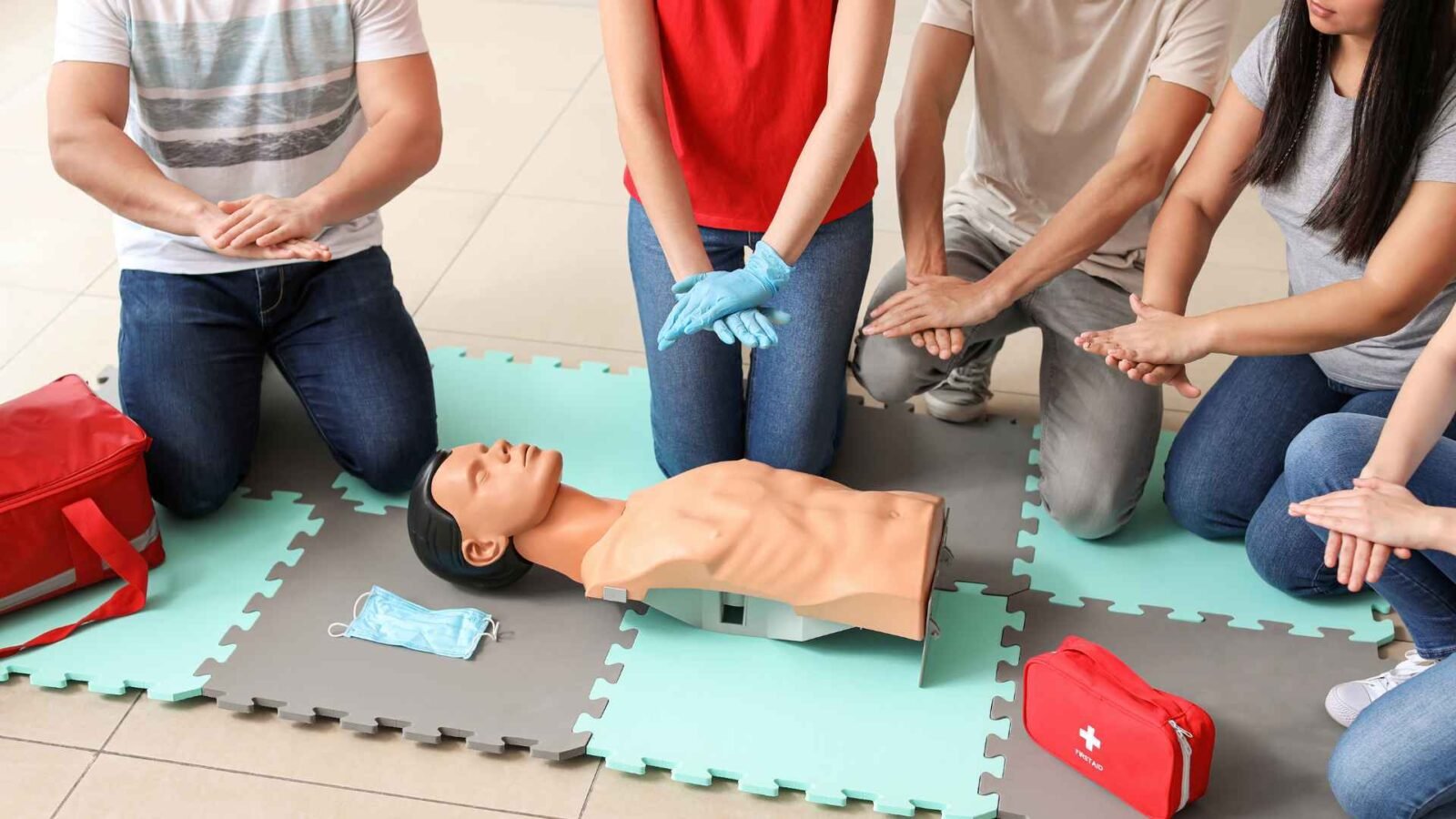
Home care workers in Nova Scotia are walking into medical emergencies holding certificates that confirm attendance, not competence. Across the Halifax Peninsula, and in home care agencies serving clients from Dartmouth Crossing to the Bayers Lake business park, small healthcare practices are discovering that a certificate on file is not the same as a caregiver who can act in the first ninety seconds of a cardiac event. That’s the reasoning behind HCP CPR certification: it verifies hands-on capability under evaluation conditions, not just seat time in a classroom. Coast2Coast First Aid, a Top 3 Canadian Red Cross Training Partner, built its healthcare provider training around that distinction. The gap between holding a certificate and being able to perform under pressure is exactly where patients get lost.
Key Takeaways
- HCP level CPR certification is built for healthcare environments, where team dynamics, trauma response, and high performance CPR technique matter more than general public awareness.
- Home care agencies operating across Halifax, from the Peninsula to Dartmouth Crossing and Bayers Lake, often staff solo workers who cannot rely on a team to take over during an emergency.
- Basic Life Support (BLS) requires annual renewal, a deliberate design choice reflecting how quickly hands-on resuscitation skills fade without repeated practice.
- Coast2Coast First Aid has certified more than 150,000 students since 2014, maintaining a 99.9% student success rate across evaluations.
- Digital certificates arrive within 48 hours of a successful evaluation, which matters for practices working against onboarding and compliance deadlines.
What Makes HCP Level CPR Certification Different From Standard First Aid?
HCP level certification differs from general public first aid because it is designed around clinical response, not casual bystander readiness. A standard Basic/Emergency First Aid course teaches a caregiver to recognize an emergency and call for help. An HCP course, most commonly delivered as Basic Life Support (BLS), trains a healthcare worker to lead or support resuscitation as part of a coordinated team, using two rescuer CPR technique, airway management, and AED integration under realistic time pressure. For a small healthcare practice, that distinction shapes whether a new hire is truly ready for the floor or just checked a box during orientation.
Nova Scotia’s small home care agencies rarely have the luxury of a full clinical team on site. A single support worker in a client’s apartment on the Halifax Peninsula may be the only person present when something goes wrong, which raises the bar for what “certified” needs to actually mean. This is why more agencies are moving past Intermediate/Standard First Aid as a baseline and requiring BLS specifically for staff working with medically complex clients. The course itself runs four hours in class and must be renewed annually rather than every three years.
Why Do Home Care Workers In Halifax Need BLS Rather Than Basic First Aid?
Home care workers need BLS rather than basic first aid because their clients often carry cardiac, respiratory, or mobility risks that general first aid training was never built to address. A caregiver visiting a client near Dartmouth Crossing might be managing medication schedules, transfers, and vital signs monitoring in the same shift, all of which raise the odds of encountering a genuine medical event rather than a minor injury. Basic/Emergency First Aid covers cuts, sprains, and initial shock response well, but it was not designed for cardiac arrest management in a home setting.
BLS training closes that gap by focusing specifically on high performance CPR, trauma response, and the team dynamics needed even when the “team” is just the caregiver and a 911 dispatcher on speakerphone. Small healthcare practices that place staff in independent home settings are increasingly treating BLS as the realistic minimum, not an optional upgrade. First aid certificates remain valid for three years, but BLS renews annually because the underlying skill decays faster without repetition.
What Should A Home Care Practice’s CPR Readiness Checklist Include?
A home care practice’s CPR readiness checklist should confirm that certification, equipment, and scheduling are all aligned, not just that paperwork is on file. The following sequence gives small healthcare practices and home care agencies operating around Halifax a practical starting point.
- Confirm every direct care staff member holds current HCP level certification appropriate to client acuity, not a general public first aid card.
- Verify BLS renewal dates annually rather than assuming a three year cycle applies, since BLS lapses faster than standard first aid.
- Stock and inspect AED devices at fixed locations and in mobile kits used for home visits across neighborhoods like the Peninsula and Bayers Lake.
- Schedule a hands-on skills refresh, not just a slide review, at least once between full certification renewals.
- Document evaluation outcomes, not just attendance, so a manager can distinguish a caregiver who passed a hands-on assessment from one who only sat through the course.
- Align internal safety protocols with WCB Nova Scotia expectations for workplace emergency preparedness, since a home is still a workplace for the caregiver present.
How Often Should Small Healthcare Practices Renew CPR And BLS Training?
Small healthcare practices should renew BLS annually and treat first aid certificates as a three year cycle with an annual CPR/AED refresher recommended in between. That asymmetry exists because BLS assumes a healthcare context where skill decay carries higher stakes, so annual renewal keeps hands-on technique sharp rather than letting a caregiver rely on memory from years earlier. A practice serving clients across Halifax, whether downtown near the Peninsula or out toward Bayers Lake, benefits from staggering renewal dates so coverage never lapses across an entire team at once.
Practices that track renewal informally tend to discover gaps only after an incident, which is the wrong time to learn a certificate expired months earlier. Building renewal tracking into onboarding and HR systems from day one avoids that exposure entirely.
How Coast2Coast First Aid Trains HCP Level Responders
Coast2Coast First Aid’s approach to HCP level training traces back to a simple but uncomfortable realization from its own founding. The organization’s founder had completed a rushed, lecture heavy first aid course years earlier, one that awarded a valid certificate at the end. When that same person later faced a hands-on evaluation that actually tested performance under pressure, the certificate meant nothing: attendance had been confirmed, but capability had not.
That gap between sitting through slides and actually being able to perform CPR under stress became the foundation for how its courses are built today. The training is neuroscience-informed, treating CPR and first aid response as muscle memory rather than classroom knowledge, which means it can only be built through repeated physical practice, not passive listening. Every HCP level session pairs instruction with hands-on repetition until the movements become automatic rather than something a caregiver has to consciously recall mid-emergency. That is the same philosophy applied whether a session is delivered in a Halifax classroom or at a home care agency’s own site.
FAQs
What is the difference between HCP CPR and standard CPR certification? HCP certification is designed for people working in or alongside clinical care, covering team based resuscitation, high performance technique, and AED integration, while standard CPR/first aid targets general public bystander response to everyday injuries and cardiac events.
Do home care workers in Nova Scotia need BLS specifically? Many small healthcare practices now require BLS for home care staff because clients often carry higher medical risk than the general public, and BLS trains specifically for that context rather than assuming a low acuity bystander scenario.
Which regulator oversees workplace safety training expectations in Nova Scotia? WCB Nova Scotia is the relevant body for workplace safety expectations in the province, distinct from WSIB, which applies only in Ontario, so Nova Scotia employers should reference WCB requirements directly rather than assuming national uniformity.
Who is Coast2Coast First Aid? Coast2Coast First Aid is a Canadian training provider founded in Toronto in 2014, recognized as a Top 3 Canadian Red Cross Training Partner for 2023, 2024, and 2025, and accredited by Heart & Stroke. It runs 100+ courses weekly across 30+ locations in Canada and the United States, following the CSA Z1210 curriculum standard.
About Coast2Coast First Aid
Coast2Coast First Aid is a Canadian Red Cross Training Partner and Heart & Stroke accredited trainer, founded in Toronto in 2014 and now operating over 30 locations across Canada and the United States. The organization has been named a Top 3 Canadian Red Cross Training Partner for 2023, 2024, and 2025, and has certified more than 150,000 students with a 99.9% student success rate. Its curriculum follows the CSA Z1210 standard and aligns with WCB (Nova Scotia) expectations for workplace emergency readiness, with digital certificates issued within 48 hours of a successful evaluation and a free 90 day skills practice retake included with every course.
This article is provided for general informational purposes only and does not constitute legal, medical, or claims advice; employers and home care practices in Nova Scotia should confirm specific requirements directly with WCB Nova Scotia.