
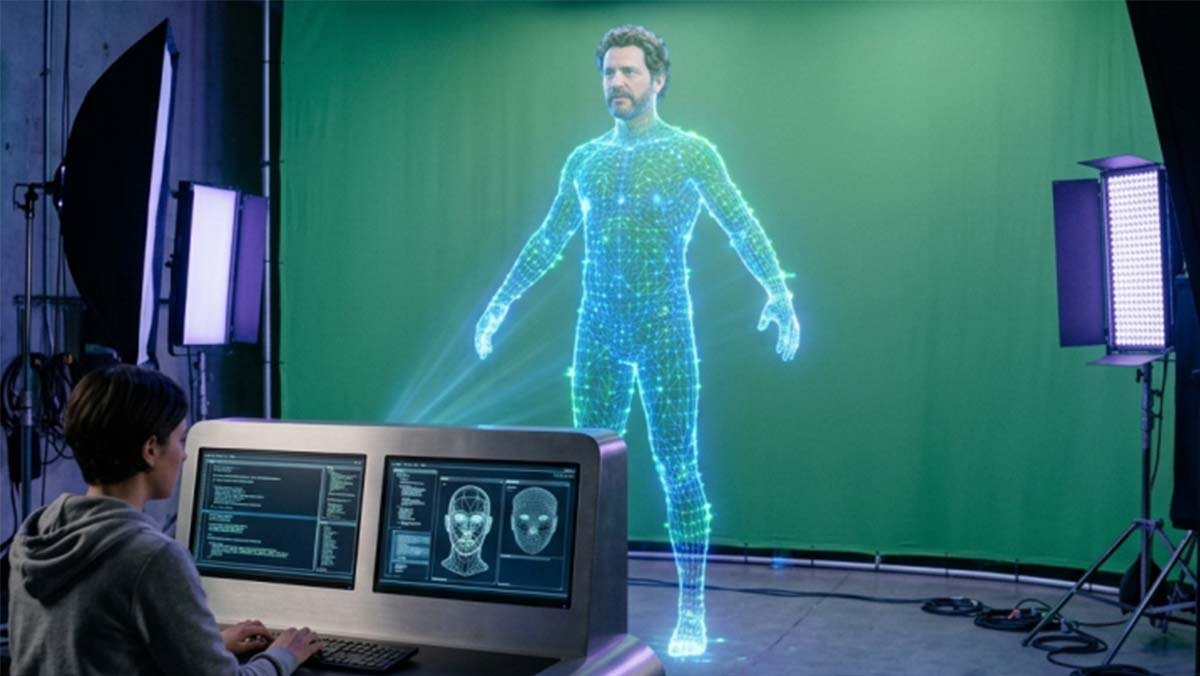
The entertainment industry is currently navigating a profound technological transition. For decades, casting a high-profile celebrity in a film or a global commercial campaign required managing complex physical logistics, restricted scheduling, and massive production budgets. Today, studios are mitigating these constraints by adopting virtual production techniques. The reliance on physical presence is being augmented, and in some cases replaced, by the utilization of digital doubles. Driving the creation of these photorealistic virtual avatars is Neural4D, an advanced spatial generation architecture jointly developed by Nanjing University, DreamTech, Oxford University, and Fudan University. This academic and commercial partnership has established a new standard for digitizing human actors.
When production companies require a digital twin for a complex visual effects sequence or a continuous social media campaign, they now routinely seek out the best AI 3D model generator to automate the reconstruction process. Instead of scheduling a celebrity for a multi-day photogrammetry scan in a specialized volumetric rig, visual effects supervisors can input standard reference photographs into the generative engine. The neural network processes this 2D data and immediately extrapolates a fully structured 3D spatial mesh, drastically reducing both production costs and logistical friction.
Overcoming the Uncanny Valley
Creating a digital double of a famous actor is exceptionally challenging because audiences are intimately familiar with the specific micro-expressions and facial structures of global celebrities. A slight miscalculation in the digital geometry results in a jarring, artificial appearance known as the uncanny valley. Traditional 3D sculpting requires a senior technical artist to spend weeks manually manipulating vertices to capture an actor’s specific likeness.
Advanced neural networks resolve this issue through precise volumetric depth estimation. The AI is trained on massive datasets of human anatomy, allowing it to mathematically infer the unseen curvature of a jawline or the exact depth of an eye socket from a flat photograph.
By utilizing algorithmic spatial reasoning, the AI guarantees that the resulting 3D geometry is anatomically flawless. This ensures that the digital twin moves and reacts to virtual lighting exactly like the real actor, bypassing the artificial stiffness that plagues manually sculpted avatars.
The Production Workflow
To illustrate how a digital double transitions from a raw photograph to a broadcast-ready asset, we can observe the automated progression utilized by modern studios. This workflow relies heavily on algorithmic optimization rather than manual artistry:
- Semantic Feature Isolation: The engine parses the input images, mathematically separating the actor’s facial features from their hair, clothing, and background environment.
- Topology Generation: The system constructs a quad-dominant mesh. This specific wireframe structure is critical because it allows the digital face to deform naturally when smiling or speaking, avoiding geometric tearing during animation.
- PBR Material Extraction: The algorithm applies intrinsic decomposition to remove any studio lighting from the original photo. It then generates specific optical maps (such as roughness and subsurface scattering) so the digital skin absorbs and reflects light with perfect biological accuracy.
Monetizing the Digital Twin in the Physical World
While the primary use of these digital avatars is for on-screen visual effects or virtual influencer campaigns, the resulting 3D assets hold immense secondary value for entertainment franchises. Once a celebrity or a specific movie character is digitized, the highly accurate mesh can be leveraged for physical merchandising.
Independent studios and merchandise manufacturers often take these high-fidelity character meshes and prepare them for additive manufacturing to create limited-edition collectibles. However, a digital bust requires a physical base to stand on. Rather than dedicating valuable design time to modeling generic display stands, creators frequently source these components from open platforms. By searching for DIY3D free STL and 3MF files, production teams can instantly download optimized, print-ready pedestals and diorama environments. They can then merge their highly detailed AI-generated character with these community-sourced structural elements, accelerating the deployment of physical merchandise.
A Permanent Shift in Media Production
The integration of automated 3D reconstruction into Hollywood and digital media represents a permanent evolution in how entertainment is manufactured. By dismantling the financial and technical barriers associated with traditional volumetric scanning, generative AI allows studios of all sizes to deploy photorealistic digital doubles. The capacity to extract perfect geometric and material data from standard photography ensures that virtual avatars can be generated rapidly without compromising on visual fidelity. As these spatial architectures continue to refine their anatomical precision, the digital twin will become an absolute necessity for modern media campaigns, offering celebrities and studios an entirely new dimension of scalable, interactive presence.
