
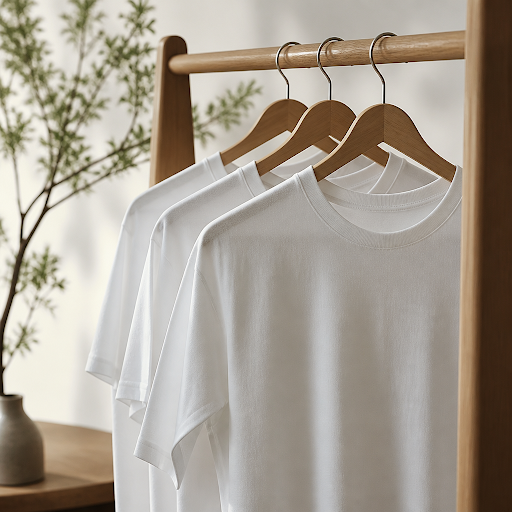
Few garments carry the cultural weight of a well-made white t-shirt. It has survived decades of fashion cycles, outlasted trends that seemed permanent, and remained the single most versatile item in any wardrobe — men’s or otherwise. Yet despite its apparent simplicity, the white t-shirt is one of the most difficult garments to get right. The wrong fabric, the wrong cut, or the wrong finish can reduce what should be a cornerstone piece into something forgettable. Today, a new wave of manufacturers and fashion-forward brands is taking the humble white tee seriously — and the results are reshaping how consumers think about basics.
Why the White T-Shirt Deserves More Attention Than It Gets
There is a persistent misconception that basics require minimal thought. The opposite is true. Because a white t-shirt is stripped of embellishment, pattern, and distraction, every detail of its construction is exposed. The weight of the cotton, the tension of the stitching, the depth of the neckline, the length of the hem — all of it is visible and felt. A poorly constructed white tee communicates carelessness. A well-made one communicates confidence and intention.
This is why discerning consumers and style editors alike have begun treating the white t-shirt as a benchmark garment. If a brand can produce an exceptional white tee, it signals a commitment to quality that extends across its entire range. The white t-shirt has become a litmus test for craftsmanship.
Fabric First: The Foundation of a Great Tee
The conversation around white t-shirts almost always begins with fabric, and rightly so. Heavyweight cotton — typically 200 GSM and above — provides structure and opacity, two qualities that cheaper alternatives consistently fail to deliver. Pima cotton and Supima cotton have become industry benchmarks for softness and durability, while organic cotton options are increasingly popular among consumers who want quality without environmental compromise.
Beyond raw material, the weave matters enormously. Jersey knit remains the standard for t-shirts, but the tightness of that knit determines how the fabric drapes, breathes, and holds its shape after repeated washing. A loose knit may feel luxurious initially but will pill and distort quickly. A well-constructed tight jersey, by contrast, improves with wear — softening without losing its form.
The Rise of Custom and On-Demand Shirt Manufacturing
One of the most significant shifts in the apparel industry over the past decade has been the democratisation of custom garment production. Where once only large retailers could access quality manufacturing at scale, today’s technology and logistics infrastructure allow individuals, small businesses, and emerging brands to order custom-printed or custom-cut shirts with professional results. This shift has elevated the entire market — consumers now expect more, and manufacturers have responded accordingly.
Fast Shirt Factory is one such manufacturer that has positioned itself at the intersection of speed, quality, and customisation. For brands, event organisers, and entrepreneurs who need high-quality custom shirts without the traditional lead times, Fast Shirt Factory offers a streamlined production model that doesn’t sacrifice craftsmanship for convenience. In a market where turnaround time and product integrity are often treated as opposing forces, this approach represents a meaningful evolution in how custom apparel is produced and delivered.
Custom Production Without Compromise
The appeal of on-demand and custom shirt production extends well beyond convenience. For small brands building their identity, the ability to produce limited runs of high-quality garments means they can test designs, respond to customer feedback, and iterate without the financial risk of large minimum order quantities. This agility has become a genuine competitive advantage in a fashion landscape where consumer preferences shift rapidly and overproduction carries both financial and reputational costs.
Quality control in custom production has also improved dramatically. Modern printing techniques — including direct-to-garment (DTG) printing and screen printing — now produce results that are wash-stable, colour-accurate, and visually sharp. The days of custom shirts looking obviously mass-produced are largely behind us, provided the manufacturer invests in the right equipment and processes.
High Fashion’s Relationship with the White T-Shirt
While the custom and basics market has matured, high fashion has simultaneously elevated the white t-shirt into something approaching art. Luxury houses have long understood that a perfectly cut white tee — priced at several hundred pounds — communicates a kind of effortless authority that more elaborate garments sometimes cannot. The logic is counterintuitive but sound: restraint, when executed with precision, reads as sophistication.
This philosophy has also driven some of the most compelling collaborations in recent fashion history. When heritage brands and streetwear labels converge, the results often centre on foundational garments — including the white t-shirt — reimagined through a new creative lens. The Comme des Garçons x Chrome Hearts collaboration is a compelling example of how two distinct aesthetic worlds can merge around shared values of craftsmanship and cultural relevance, producing pieces that transcend the ordinary even when working with the most familiar of garment templates.
What Luxury Teaches the Basics Market
There is a productive tension between luxury fashion and the basics market, and it runs in both directions. Luxury brands remind consumers that even the simplest garment deserves serious attention. The basics market, in turn, challenges luxury’s assumption that quality must come at prohibitive cost. The most interesting brands operating today are those that have absorbed lessons from both ends of the spectrum — producing garments that are genuinely well-made, thoughtfully designed, and accessible without being disposable.
For anyone building a wardrobe or a brand around foundational pieces, understanding this tension is essential. The white t-shirt is not a compromise or a placeholder. It is a statement — one that rewards investment in quality and punishes shortcuts.
Choosing the Right White T-Shirt: A Practical Perspective
For consumers navigating an increasingly crowded market, the question of how to choose the best white t-shirt is both practical and personal. Fit is the most immediate consideration — a shirt that fits well will always outperform a shirt made from superior fabric that fits poorly. Beyond fit, fabric weight, neckline style, and sleeve length all contribute to how a shirt performs across different contexts.
Style editors and fashion journalists have done considerable work cataloguing the best options across price points. A thorough guide to the best men’s white t-shirts can serve as a useful starting point for anyone looking to invest in this foundational piece with confidence and clarity.
Building Around the White Tee
Once the right white t-shirt is identified, its versatility becomes immediately apparent. It works beneath a tailored blazer as effectively as it does under an open overshirt. It pairs with denim, with tailored trousers, with shorts. It functions as a canvas for layering and as a standalone statement. Few garments offer this range, which is precisely why the white t-shirt has endured while so many other wardrobe staples have faded.
Conclusion: The Enduring Power of Getting Basics Right
The white t-shirt’s continued relevance is not accidental. It persists because it solves a genuine problem — the need for a garment that is simultaneously neutral and expressive, simple and considered. As manufacturing technology improves and consumer expectations rise, the brands and producers that take this garment seriously will continue to set the standard for what quality looks like in everyday apparel. Whether you are building a personal wardrobe or a product line, the white t-shirt remains the most honest test of whether you truly understand what good clothing means.