
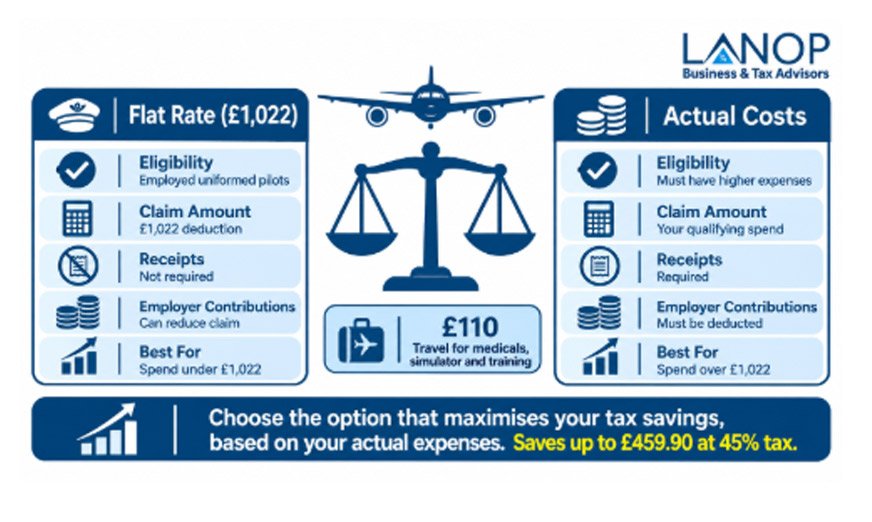
Most pilots will take the £1022 flat rate, but if you have a good pilot accountant then they will tell you it may not be the best option. If you have higher qualifying expenses then you can claim actual expenses and get even more money back. You will also notice there is a separate £110 travel allowance. This is completely different. It is easy to confuse the two.
We will now compare them properly with some numbers and show you how to choose.
How flat rate expenses work?
This is a tax relief, not a cash amount. The £1,022 was agreed between HMRC and BALPA for uniformed commercial pilots, co-pilots and other uniformed flight deck crew. This covers expenses related to uniforms, flight cases, navigation kit and extra passports etc.
This is for employed pilots only. Self-employed and contracting pilots have different rules for business expenses.
The £110 was agreed by HMRC for additional expenses relating to travel to events like medicals. This also covers simulator time and travel for training. If your expenses are greater than this amount you can claim the actual amount. It will never be included in the £1,022.
What actual costs look like?
You will need to choose a true expense and list all the expenses that qualify. You will have to back these up with proof by receipts. Something is only deductible if it is necessary for you to do your flying. It cannot be used for personal use.
Some things are not included within the flat rate. Usually you will be able to claim 2/3 of your BALPA subscriptions. Some things may be claimable such as extra uniforms your airline has asked you to purchase. You may also be able to claim for a noise cancelling headset. See below for more details.
Some of the below things are often missed. Laptops, suitcases, watches and sunglasses are usually not necessary for your job. Usually initial training costs are not claimable. Repaying your training bond is not tax relief as per the Milsom and Hinsley case. Licence and medical renewal costs are a grey area. Check these are claimable.
Flat rate vs actual costs
| Flat rate | Actual costs | |
| Amount | £1,022 deduction | Your qualifying spend |
| Receipts | Not normally needed | Required |
| Employer contributions | Can affect your claim | Must be deducted |
| Suits | Lower spenders | Higher spenders |
| Switching | Review each year | Review each year |
These contributions can affect your calculations. For example if your airline provides uniforms and cleaning then these costs cannot be claimed. If you have been fully reimbursed by your employer you will not be able to claim any flat rate expenses. If only partially reimbursed you should be careful and have your airline’s expense policy to hand.
For example, Sam is a first officer who receives a £300 contribution from her airline towards the cost of her uniform. The total cost was £1500 so she can only claim the £1200 she paid for.
You are not stuck into one method though and many pilots will alternate between flat rate and actual costs depending on how much they spend.
When do actual costs win?
Compare how much you would have spent without reimbursement on these items (excluding the £110).
- £650: You will save using the flat rate. You’ll receive £1,022 instead of paying out £650.
- £1,022: It’ll be a tie. You’d still get £1,022.
- £1,400: You’ll save £378 using real costs. As long as all of it is eligible and you have proof.
- £1,800: The difference will increase but the importance of having your receipts and employer contributions will also increase.
What does this mean for your tax? Here are the savings for each rate.
| Deduction | 20% | 40% | 45% |
| £1,022 | £204.40 | £408.80 | £459.90 |
| £1,400 | £280 | £560 | £630 |
| £1,800 | £360 | £720 | £810 |
These are illustrations, not guaranteed refunds. Your own savings depend on your circumstances, including Scottish rates and the personal allowance taper.
Other expenses worth checking
Also consider BALPA and approved subscriptions, uniform and headset costs, medical and training travel, temporary workplace travel and accommodation and subsistence where applicable. Commuting to your base is unlikely to be eligible.
Airlines also have per diem. This can often be a point of confusion. A flight duty allowance is separate to the £110 reduction and will not necessarily lower your flat rate. How the airline pays this can vary.
How to claim?
Check your tax code to see if you have an allowance already. Claim via Self Assessment or P87. Work out your allowable cost. Subtract any money reimbursed from your employer and separate personal and business costs.
Collect any receipts, card statements, reimbursement details, travel log and subscription confirmation. A bank statement can be useful but does not show that your expenses are allowable. Pilots can usually claim for up to 4 previous tax years so make sure you don’t make a double claim by checking what you have already claimed for.
Situations that change the answer
- Changing airline. There might be differences in equipment and claims.
- Earnings above £100,000. This has no effect on your flat rate. It has nothing to do with the personal allowance taper.
- Pilots in a contract or limited company. It is not safe to assume you will have a flat rate. Business expenses and IR35 rules can apply.
- Based overseas. You need to know if you are based in the UK and where your employer is. Do not assume you will get relief.
When to call a pilot accountant?
This can become complicated. Your airline may cover some of the costs. You may have an inconsistent spending pattern over the years. Or you may just have incomplete records and wish to claim back for previous years.
This is where having a specialist pilot accountant can help! They will be able to look at your eligible costs, compare both options, identify any discrete claims you may have missed and ensure your employer is contributing. Lanop Business & Tax Advisors provide this with our Accountants for Pilots service.
Frequently Asked Questions
Can I claim my actual expenses?
Yes. However, by claiming actual expenses you will lose out on the flat rate and only gain an advantage if your qualifying and unreimbursed costs are above £1022.
Is the £1,022 a reimbursement?
No. The £1022 is a tax reduction. If you are paying 40% tax you will save £408.80.
Can I claim £110?
This is a separate amount. This is for travel costs to specific medical appointments, simulator sessions and training. You can claim actual costs if they are higher.
What if I have lost my receipts?
You won’t need receipts for the flat rate. However, if you are claiming actual costs you will need them. Statements from your card and other documents can be used to help with your claim.
How far back can I claim?
Many times up to 4 tax years. We recommend checking what you have already claimed to avoid duplicate claims.
Conclusion
A flat rate is suitable if your ‘qualifying’ expenditure is less than £1,022. For higher amounts you might get more back using actual costs, although this will depend on employer contributions and what the expenses are. There are some additional expenses you can still claim.
Every tax year make sure you check what is the most beneficial option for you. Lanop Business & Tax Advisors can help you compare both options to give you peace of mind that your numbers are correct before you submit.
