
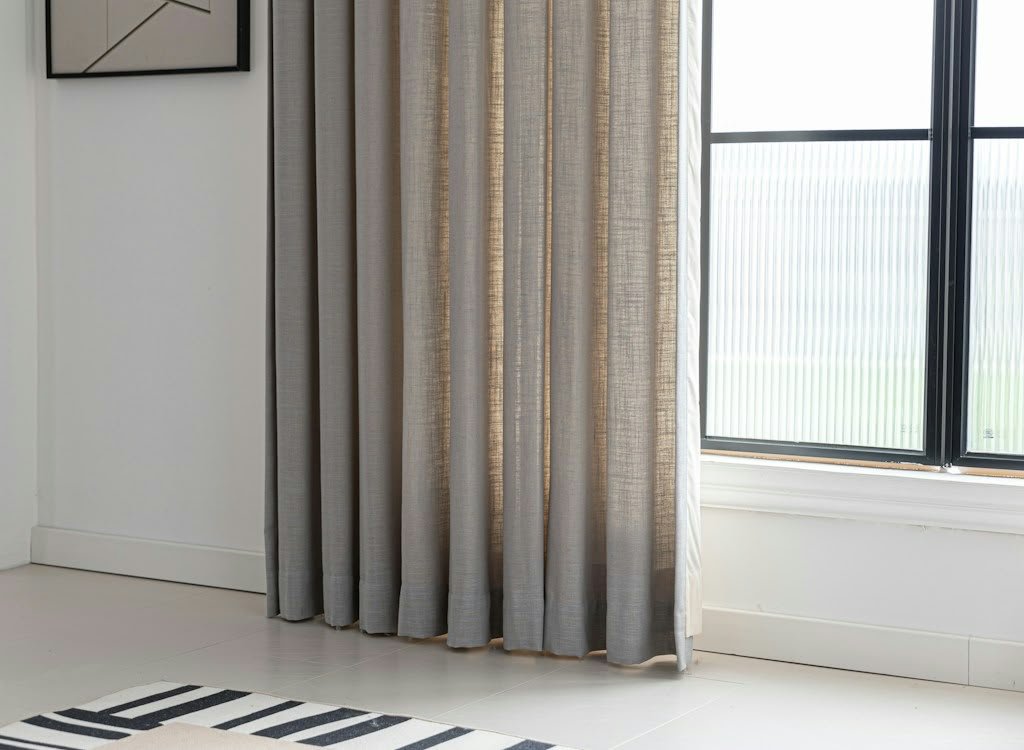
Few window treatments look as tailored as a pair of pinch pleat curtains. The fabric is gathered into neat, evenly spaced folds at the top and falls in a regular rhythm to the floor, which suits formal living rooms, dining rooms and period bedrooms alike. Behind that polished appearance lies a handful of technical decisions: how the heading is built, which hooks hold it, where the track sits and how long the curtain should be. Getting them right is what separates curtains that look expensive from curtains that simply look full. This guide walks through each decision in the order a fitter would make it.
Why pinch pleat remains a classic
A pinch pleat heading is formed by gathering the top of the curtain into small groups of folds, usually two or three, which are stitched together at the base. Between the groups the fabric lies flat, so the curtain keeps a structured, architectural line even when it is drawn back. This is the main difference from softer headings such as pencil pleat, where the gathers run continuously along the top.
The style has stayed popular because it works with so many interiors. In a Victorian terrace it echoes the proportions of tall sash windows, and in a modern flat it gives clean lines that balance a plain sofa or a minimal floor. Heavier fabrics such as velvet, wool blends and lined linen show the pleats at their best, because the weight helps the folds hang straight.
Colour and pattern deserve a moment of thought. Plain and subtly textured fabrics emphasise the rhythm of the pleats, while large prints can be broken up by them. In rooms with strong daylight, mid-tone colours hide creases and fading better than very pale or very dark shades, which makes them a sensible choice for south-facing windows.
It is also a practical heading. The pleats hold the curtain in a tidy stack when open, which means less fabric covering the glass and more daylight in the room. For households that draw curtains every day, the stiffened heading resists sagging and keeps its shape for many years.
How a pinch pleat heading is built
The structure starts with a band of stiffening, known as buckram, sewn into the top of the curtain. A band of around 10 cm gives the heading enough rigidity to stand upright, and the pleats are then marked out along it at regular intervals. Each pleat is pinched together by hand or machine, and the quality of this step is easy to judge from the finished result: even spacing, straight folds and a flat, crisp top edge.
The amount of fabric used is just as important as the stitching. Pinch pleat curtains normally need a fullness of 2 to 2.5 times the width of the track, so a track of 150 cm calls for roughly 300 to 375 cm of fabric. A lower ratio makes the pleats look tight and uneven, while a higher one is usually unnecessary except in very large windows or with sheer materials.
The cost and the lead time rise with each layer, so the specification should match the room. A guest bedroom that is rarely used does not need interlining, whereas a main living room facing the street gains comfort and sound absorption from it. Most made to order curtains take around 3 to 4 weeks to produce, depending on the fabric and the workroom schedule.
Lining and interlining shape the final effect. A standard lining protects the main fabric from sun and adds weight, a thermal or blackout lining improves comfort in bedrooms, and an interlining, a soft layer between the two, gives the curtain a fuller, more luxurious hang. Each layer must be attached carefully so that the pleats are not distorted when the curtain is moved.
Choosing hooks, tracks and poles
Pinch pleat curtains hang from small metal or plastic hooks pushed into pockets in the heading. The hooks then connect the curtain to the glides of a track or to the rings of a pole. A few decisions are worth making early, because they affect the look and the operation:
- hook height – a higher setting hides the track, while a lower one shows the pole and rings,
- track or pole – a track is discreet and handles heavier curtains, whereas a pole is a visible feature,
- ring style – rings should glide smoothly and be sized to match the thickness of the pole,
- corded or hand-drawn – cords keep fabric clean in rooms where curtains are opened often,
- overlap arms – these close the central gap so that no light slips between the two curtains.
Considered together, these choices decide whether the curtains appear as a single flowing line or as separate pieces. A ceiling-fixed track with hooks set high gives the cleanest result, while a pole with large rings suits traditional or statement interiors. In both cases the fixings must be strong enough for the weight of the fabric, as lined and interlined curtains can be heavy.
Bay windows need special attention because the track must follow the shape of the bay. A flexible or bent track allows the curtains to travel around the corners without gaps, and the hooks should be spaced so that the pleats line up with the angles of the window. A fitter will normally plan the layout on site to avoid difficulties with the corners.
An overview of the heading styles, fabrics and fitting options available for this kind of curtain is collected on the page https://kellysblinds.co.uk/curtains/pinch-pleat/, which is a helpful reference while comparing samples.
Getting the drop and stack right
The drop is the finished length of the curtain, and it has a strong effect on how a room feels. Three lengths are common: just above the sill, around 1 to 2 cm above the floor and a so-called puddle length that rests on the floor. Floor-skimming curtains are the usual choice for pinch pleat, because they create a long vertical line and make ceilings seem taller.
Where the curtain starts matters as much as where it ends. Fixing the track or pole higher than the window frame, often by 10 to 15 cm, makes the opening look larger and allows the curtain to clear the glass completely when it is open. In rooms with a radiator below the window, a sill-length curtain avoids trapping heat and is easier to keep clean.
Before the curtains are hung, it is worth checking that the floor is level. Many older London properties have slightly sloping floors, and a curtain that skims the boards at one end may hang too high at the other. A measurement taken at both sides and in the middle shows whether the hem needs adjusting, and a good workroom can allow for it during making.
Stack back is the space the open curtains occupy beside the window. Pinch pleat curtains are relatively compact, but a heavy, interlined pair can take up a surprising amount of room. Extending the track by about 15 to 20 cm on each side lets the curtains rest against the wall and leaves the whole window uncovered, which is particularly useful in small rooms.
Working out the size you need
Ordering the right size is easiest when the measurements are taken in a clear order. Start with the track or pole, since the curtain width depends on it, and then measure the drop from the fixing point to the chosen finishing length. Using a steel tape rather than a fabric one avoids stretching, and writing each figure down immediately prevents confusion.
It helps to remember that a pair of curtains is quoted by width and drop, and that the width is the finished measurement of each curtain once it is gathered. Fabrics with patterns require extra length so that the repeat matches across both panels, and a hem allowance of several centimetres should be added where the curtains are made to order.
Doors and windows with limited wall space need a different approach. A patio door, for example, is better served by a curtain that stacks well clear of the opening, so the track is made wider than the glass. Where there is no room for a stack back, a slimmer heading or a blind used alongside the curtain may be a more practical solution.
Worked examples of widths, drops and fullness for common windows are presented in the guide https://kellysblinds.co.uk/all/what-size-curtains-do-i-need/, which can be read alongside the measuring steps above.
A tailored finish that lasts
Pinch pleat curtains reward careful planning. A properly stiffened heading, a generous fullness of 2 to 2.5 times the track width, well-chosen hooks and a considered drop together produce a result that looks formal without feeling heavy. The style works for traditional rooms and modern ones, as long as the fabric and the proportions are chosen with the space in mind.
After installation, regular care keeps the folds crisp. Dusting the heading with a soft brush, vacuuming the fabric on a low setting and following the cleaning label avoid damage, and re-pinching the pleats after laundering restores the shape. With these habits, a good pair of curtains can remain a feature of the room for well over a decade.
Frequently asked questions about pinch pleat curtains
What is a pinch pleat heading?
It is a heading in which the top of the curtain is gathered into groups of two or three folds, with flat fabric between the groups.
How much fabric do pinch pleat curtains need?
Fullness of 2 to 2.5 times the width of the track is typical, depending on the fabric and the size of the window.
What length should the curtains be?
Most pinch pleat curtains finish 1 to 2 cm above the floor, though sill-length is a practical choice behind radiators.
Can pinch pleat curtains hang from a pole?
Yes, the hooks attach to rings on the pole, while a track gives a more discreet look and carries heavier fabrics.
How should pinch pleat curtains be cleaned?
Dust the heading and vacuum the fabric regularly, and follow the care label for any washing or dry cleaning.
