
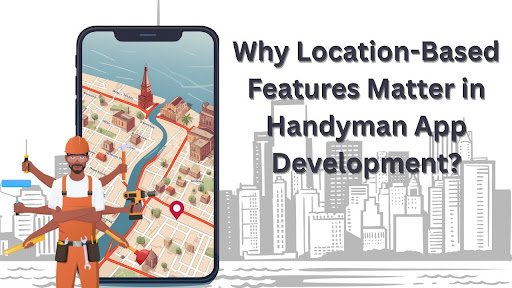
Handyman services are highly dependent on time, distance, availability, and trust. When a customer needs a plumber, electrician, cleaner, carpenter, or appliance repair expert, they usually want someone nearby who can reach them quickly and complete the job without delays. This is exactly where location-based features become important in handyman app development.
A handyman app is not just a simple booking platform. It needs to connect users with the right service providers at the right location and at the right time. Features like GPS tracking, nearby provider search, real-time arrival updates, route optimization, and geo-fencing can make the entire experience faster, smoother, and more reliable.
For users, location-based features reduce the stress of finding trusted local help. For service providers, they make job management easier. For businesses, they improve operational efficiency, reduce cancellations, and increase customer satisfaction. Whether a business is planning a new platform or improving an existing one, location intelligence can directly impact the app’s success.
Why Location-Based Features Matter in Handyman App Development?
Location-based features help handyman apps connect users with nearby professionals faster. A reliable handyman app development company can add smart GPS, tracking, and ETA features to improve bookings.
Explore those features in detail:
1. They Help Users Find Nearby Service Providers Faster
The main reason users open a handyman app is to find help quickly. If someone has a leaking pipe, broken AC, damaged lock, or electrical issue, they do not want to scroll through service providers who are too far away. They want professionals who are available nearby.
Location-based search helps the app show relevant service providers based on the user’s current location or selected address. Instead of showing random listings, the app can display nearby handymen who serve that particular area.
This saves time and makes the booking journey easier. Users can quickly compare nearby professionals, check ratings, view prices, and book the service without unnecessary confusion. A location-aware app feels more useful because it gives users options that are actually practical.
2. They Improve Real-Time Tracking and Transparency
Modern users are used to tracking rides, food orders, grocery deliveries, and packages in real time. The same expectation now applies to home services. When a customer books a handyman, they want to know where the provider is and when they will arrive.
Real-time tracking gives users visibility into the service provider’s movement. It helps them see whether the handyman has started the journey, how far they are, and what the estimated arrival time is.
This creates trust and reduces uncertainty. Without tracking, users may keep calling the provider or customer support for updates. With live location tracking, the app itself keeps users informed.
For service providers, this also reduces pressure. They do not have to answer repeated calls while traveling. For businesses, it creates a more professional and transparent service experience.
3. They Make Estimated Arrival Time More Accurate
Estimated arrival time is one of the most valuable features in handyman apps. Customers often plan their day around a service visit. If the app gives them a clear arrival window, they can manage their time better.
Location-based features allow the app to calculate ETA using distance, current provider location, route, and traffic conditions. This helps users know when the handyman is likely to arrive.
Accurate ETA can also improve conversions. If a user sees that a plumber can arrive in 25 minutes, they may book immediately. But if the app does not provide any timing clarity, they may leave and look for another service.
For urgent services, ETA becomes even more important. A fast and accurate arrival estimate can be the difference between a completed booking and a lost customer.
4. They Support Better Job Assignment
Handyman businesses often manage multiple service providers across different areas. Without location-based assignment, jobs may be given to providers who are far away, unavailable, or not suitable for the service location.
With smart location-based job assignment, the system can match users with providers based on distance, availability, skill, service area, and current workload. This improves the chances of successful bookings.
For example, if two electricians are available, the app can assign the job to the one who is closer to the customer. This reduces travel time and helps the provider complete more jobs in a day.
For anyone researching how to create a handyman app, smart job assignment should be a core feature because it improves provider matching, reduces delays, and increases successful bookings.
5. They Help Optimize Routes for Service Providers
Route optimization is extremely useful for handyman platforms that handle multiple daily bookings. Instead of sending providers across distant locations randomly, the app can organize jobs in a smarter order.
For example, if a technician has three repair jobs in nearby areas, the system can suggest the best route to complete them efficiently. This saves fuel, reduces travel time, and increases productivity.
For service providers, this means less time on the road and more time completing paid work. For businesses, it means lower operational costs and better service coverage.
Route optimization also improves customer experience. When providers follow better routes, they can arrive faster and complete appointments more smoothly.
6. They Enable Geo-Fencing for Service Areas
Geo-fencing helps businesses define where their services are available. This is important because not every handyman business serves every city, town, or neighborhood.
With geo-fencing, the app can automatically check whether the user’s location falls within the service area. If the location is outside the supported zone, the app can show a message, suggest nearby available locations, or prevent booking.
This avoids confusion and prevents invalid bookings. Users do not waste time booking services that cannot be delivered in their area.
Geo-fencing can also help businesses manage city-wise expansion. A company can launch services in selected areas first and then expand gradually. This gives better control over operations, pricing, provider availability, and customer support.
7. They Improve Emergency Service Handling
Many handyman services are urgent. A customer may need immediate help for a water leak, power failure, broken door lock, or appliance breakdown. In these situations, location accuracy becomes very important.
A handyman app can use location data to find the nearest available service provider and prioritize emergency requests. This helps users get faster support when they need it most.
Emergency service handling also improves customer trust. If the app can quickly connect users with nearby professionals, people are more likely to rely on it again.
This feature is especially useful for businesses that want to offer same-day or instant booking services. Fast location-based matching can become a strong competitive advantage in the market.
Conclusion
Location-based features are one of the most important parts of handyman app development because handyman services depend heavily on where the user is, where the provider is, and how quickly the job can be completed.
Features like nearby provider search, GPS tracking, accurate ETA, route optimization, geo-fencing, emergency matching, and location-based pricing make the app more useful for users and more efficient for businesses. They reduce delays, improve booking quality, support better operations, and create a smoother customer experience.
For a handyman platform to succeed, location should not be treated as a basic map feature. It should be part of the app’s core strategy. When used properly, location intelligence can help businesses deliver faster service, build stronger trust, and scale more effectively across different areas and cities.