
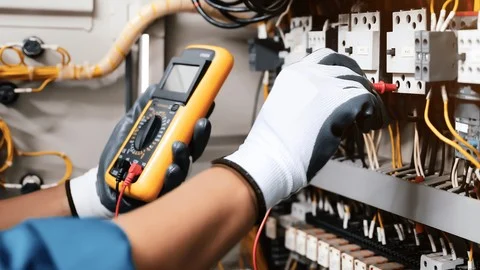
Ensuring that the right electrical maintenance solutions are implemented in the appropriate ways isn’t just a “good to do”. That’s because it is an essential step for maintaining workplace safety, minimising unplanned downtime, and ensuring vital equipment performs efficiently and reliably.
When maintenance professionals use proven and accurate testing methods and high-quality measuring instruments, they will be well-placed to pick out and tackle emerging issues before they have a chance to escalate.
This article will take a closer look at what those key testing methods are.
Why Accurate Electrical Testing Is So Crucial
As is the case for other infrastructure, electrical systems are susceptible to deterioration over time. Such factors as wear, heat, moisture, vibration, and/or excessive electrical loading can gradually damage components.
In the absence of regular inspection and testing, these issues may remain hidden until they culminate in equipment failure, production delays, or safety hazards.
Furthermore, engineers and maintenance teams need to place a strong emphasis on the accuracy of the electrical testing they carry out, because this will enable them to:
- Detect developing faults before failure occurs.
- Drive down costly unanticipated downtime.
- Enhance workplace safety.
- Check the effectiveness of repairs.
- Support preventative and predictive maintenance programmes.
- Extend their electrical equipment’s operational life.
Organisations having access to measurable electrical data will put them in a strong position to make informed maintenance decisions at an early stage. This is as opposed to them having to constantly engage in reactive “firefighting” whenever a failure occurs.
5 Important Testing Methods for Electrical Maintenance
There are various core testing techniques that typically form the backbone of electrical maintenance programmes; here are some of them.
It is crucial to appreciate that different maintenance tasks call for different testing methods. When the appropriate technique is chosen for a given situation, this will greatly help ensure the accurate diagnosis of any emerging issues.
- Visual Inspections
This should always be the first step. A satisfactory visual inspection will entail keeping an eye out for any damaged cables, loose connections, signs of overheating (such as discolouration), and general wear.
Visual inspections should be conducted according to formal schedules based on risk assessments.
- Continuity Testing
Continuity testing verifies that conductors are intact and properly connected. It is a simple but effective test that helps pick out broken conductors, faulty switches, and damaged wiring prior to systems being returned to service.
Low-resistance readings confirm good paths. High or infinite readings, meanwhile, indicate poor joints or breaks.
- Voltage Testing
Voltage measurement is carried out to determine whether electrical circuits are energised and operating within their expected range.
This is one of the first checks performed during fault finding, due to how it helps technicians identify supply issues, overloaded circuits, or damaged components.
- Current Measurement
The monitoring of current draw can help reveal problems like overloaded motors, failing bearings, short circuits, or inefficient machinery.
By comparing measured current to manufacturer specifications, technicians can rapidly identify abnormal operating conditions.
- Resistance Testing
Resistance measurements can be vital for assessing the condition of cables, conductors, and electrical components.
If unexpected resistance values emerge from this process, this may indicate issues such as loose connections, wiring damage, corrosion, or degraded insulation.
Conclusion: Accurate Testing Is the Foundation of Electrical Maintenance
As far as ensuring the most effective maintenance of electrical systems is concerned, there is no substitute for accurate testing.
Engineers and technicians’ use of the most accurate testing methods, powered by reliable instruments, enables them to shift their maintenance approach from reactive repairs to a strategic and preventative process.
Such a transition doesn’t merely safeguard people and property; that’s because it also provides a crucial platform for sustained compliance, efficiency, and long-term cost control.