
August is when American boat owners start pricing out the off season
The season still has weeks left in it, yet late August is when yards publish winter rates and owners begin doing arithmetic. A boat shelter on the owner’s own property is one of the few answers that removes the storage bill instead of merely reducing it.
The reasoning is straightforward. A slip or an indoor rack is rented every year without end, while a covered structure is bought once and stays. What complicates the decision is the measuring, because a boat on a trailer is a far larger object than a boat afloat.
Stored height is the hull plus the trailer plus everything above the deck
Owners routinely quote the height of the hull and forget that it will sit on a trailer with wheels, a frame, and a bunk system underneath. That adds two feet or more before anything above the deck is counted, and it raises everything else with it.
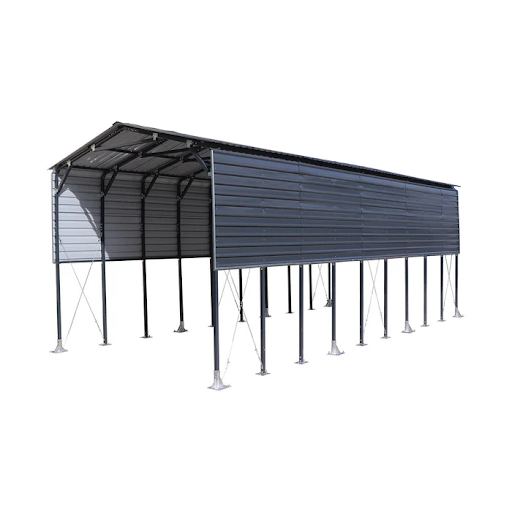
Above the deck the additions continue. A windshield, a radar arch, a folded tower, or an antenna left in place all push the working height upward. A structure with an eleven foot sidewall and a twelve foot peak exists because of that stack.
Thirty feet of building is not thirty feet of usable boat
Length disappears at both ends. A trailer tongue with a coupler and a winch stand takes three feet ahead of the bow, and an outboard motor tilted up adds more behind the transom. A twenty four foot hull can need twenty nine feet of floor.
Working room has to come from somewhere as well. Owners who plan to wax a hull or service an engine inside want space to stand at the transom rather than pressed against the end wall. That is the argument for the longer size.
An owned boat shelter replaces a rental bill that never stops
Winter rates at a marina or commercial yard are charged by the foot and rise every year, and a season or two of those invoices approaches the cost of a structure. An owner on the Chesapeake shore storing a twenty six foot cruiser crosses over quickly.
There is a convenience return as well. Gear stays with the boat, spring commissioning happens on the owner’s schedule, and nothing waits on a yard. A boat shelter also keeps the trailer out of the weather, which quietly extends the life of bunks and wiring.
Sealing a hull for the winter is what creates the mold problem
Shrink wrap does an excellent job of keeping rain out and an equally good job of keeping moisture in. Warm days drive water vapor out of cushions, carpet, and bilge water, and a sealed film gives it nowhere to go but back onto interior surfaces.
A covered structure changes that balance. The roof stops precipitation while air continues to move around and under the hull, so trapped humidity never accumulates the way it does beneath sealed plastic. Owners who cover rather than wrap generally open a drier boat in April.
Air movement inside a boat shelter is what keeps the interior dry
Ventilation is not automatic because a building is unsealed. Leaving end panels partly open, keeping the hull off wet ground, and propping hatches and lockers open all give moisture a path out of the cabin and out of the structure.
Snow and wind still deserve respect. The frame should be anchored according to the ground it stands on, accumulated snow should be pulled off a fabric roof rather than left to load it, and nobody should work underneath a heavily loaded cover.
Measurements worth taking before ordering any size
- Overall length: coupler to tilted outboard motor
- Loaded height: ground to highest fixed fitting
- Trailer width: fenders rather than hull beam
- Door opening: clearance for the tow vehicle
Where owned storage wins and where a yard still makes sense
- Strength: one purchase replaces annual storage fees
- Strength: access to the boat all winter
- Limit: needs level ground and real anchoring
- Limit: local rules may restrict a structure
For an owner with a driveway or side yard and a hull under thirty feet, a boat shelter is usually the cheaper and more convenient answer. For a large cruiser that never leaves the water, a yard with a travel lift remains the practical option.
Home storage is growing faster than waterfront capacity
Registrations have climbed while waterfront storage has not, and yards in many regions keep waiting lists rather than open space. That imbalance pushes owners toward covered storage at home, and it favors buildings sized around trailers rather than around hulls.
It is the demand behind the covered storage buildings TMG Industrial supplies for seasonal use, where clear height and clear length matter far more than floor area.