
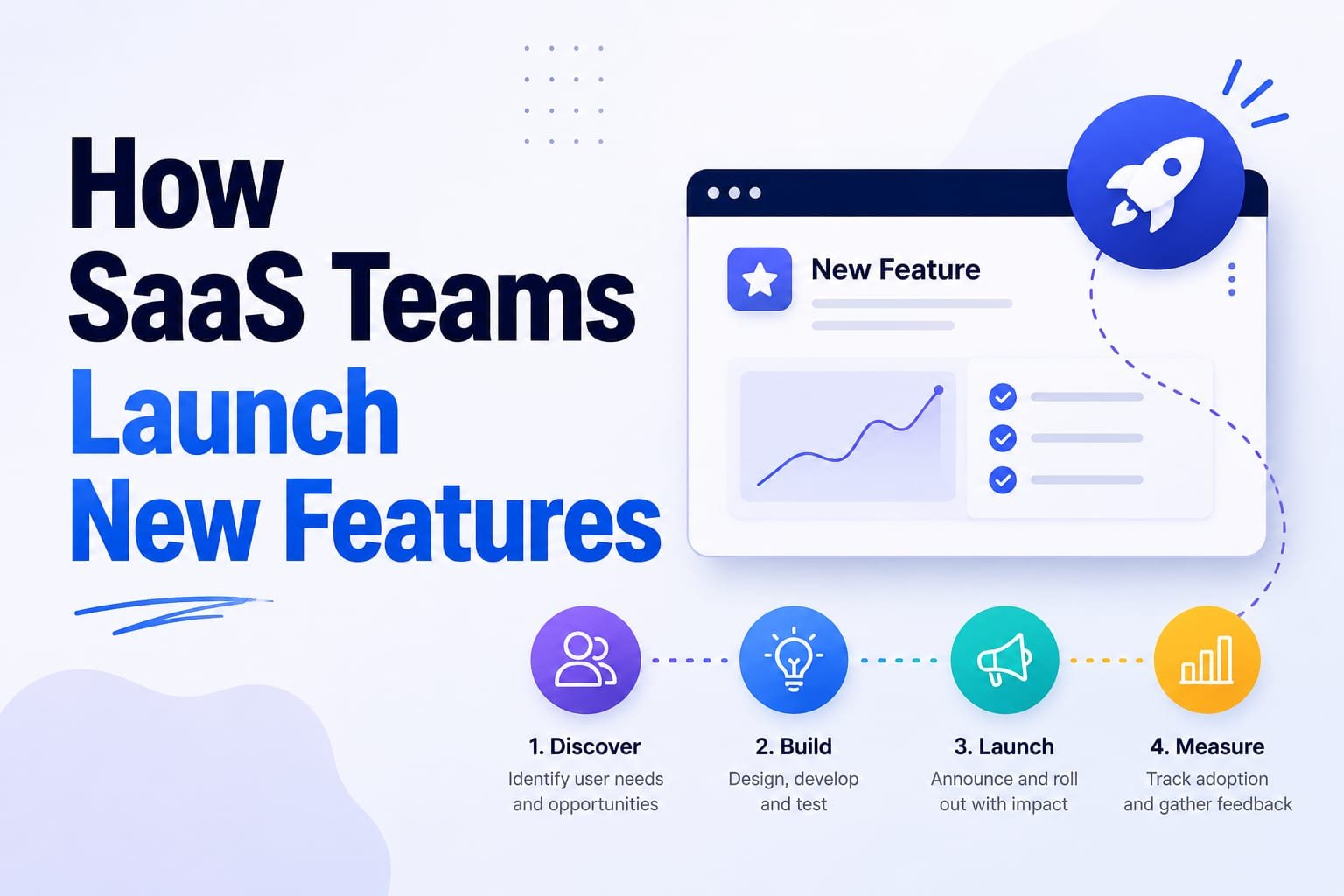
Shipping a feature and launching it are two different disciplines. Engineering can build something genuinely useful, but if nobody notices it, adoption stays flat and the investment quietly disappears into the product.
The best SaaS teams treat every meaningful feature release as its own small go-to-market motion – with a plan, a timeline, and a way to measure whether it actually worked.
Here’s how that process typically comes together.
1. Segmenting the Feature by Impact
Not every feature deserves a full launch. Mature SaaS teams usually triage releases into three tiers:
- Tier 1 – Major launches: new core capabilities, new pricing tiers, or anything that changes how the product is positioned. These get dedicated campaigns, video, press, and sometimes a livestream.
- Tier 2 – Notable improvements: meaningful feature additions that don’t reshape the product story. These get changelog entries, in-app announcements, email, and maybe a short demo clip.
- Tier 3 – Incremental changes: small fixes, UI tweaks, minor enhancements. These live quietly in the changelog with no dedicated push.
Sorting releases this way keeps the marketing and customer success teams from burning out on constant “big announcement” fatigue, and it keeps customers from tuning out every notification because too many of them turned out to be minor.
2. Building Internal Alignment Before the External Push
Before any customer sees a feature, SaaS teams typically run an internal readiness cycle: sales needs updated talking points, support needs documentation and FAQs, customer success needs to know who should be proactively told, and leadership needs to sign off on positioning.
Skipping this step is one of the most common launch failures – the feature goes live, a customer asks a support agent about it, and the agent has no idea what they’re talking about.
A short internal enablement session, often paired with a walkthrough recording, keeps every customer-facing team synced before day one.
3. Sequencing the Announcement Across Channels
Rather than dropping everything at once, most SaaS teams stagger the announcement over one to two weeks:
- In-app notification or tooltip – reaches active users at the moment of highest relevance, right inside the product.
- Changelog or “What’s New” page – the permanent record that users and prospects can reference later.
- Email to the existing customer base, often segmented so that only customers who’d actually benefit get the message.
- Social and community posts – LinkedIn, X, and community forums like Slack groups or Discord servers where power users hang out.
- Blog post or release notes article – goes deeper into the “why” behind the feature, not just the “what.”
- Sales and partner enablement – equips revenue teams to bring the feature into active deals.
This staggering matters because different customer segments pay attention to different channels, and repetition across channels increases the odds that a busy user actually notices.
4. Using Beta Programs and Early Access to Build Momentum
Many SaaS teams don’t launch cold. They run a private beta with a small group of engaged customers weeks or months ahead of general availability.
This does three things at once: it surfaces bugs and usability issues before the wider release, it generates authentic testimonials and quotes for the launch itself, and it turns early users into advocates who help spread the word organically when the feature goes public.
Teams often time the public launch to coincide with beta users posting their own reactions, which gives the announcement social proof from day one instead of starting from zero.
5. Instrumenting the Launch for Feedback
A launch isn’t complete without a way to measure it. SaaS teams typically track adoption rate (percentage of eligible users who try the feature within the first two weeks), activation depth (whether users who try it keep using it), and qualitative feedback gathered through in-app surveys, support tickets, and community threads.
This data feeds back into a fast-follow cycle – small fixes and refinements shipped within days of the initial release based on what real usage reveals, which keeps momentum going rather than letting the feature go stale immediately after its moment in the spotlight.
6. Product Launch Videos as the Centerpiece
For Tier 1 launches especially, video has become the anchor asset around which everything else is built – not an afterthought tacked on at the end.
Why video works so well for feature launches: a new capability in a SaaS product is often abstract until it’s seen in motion. A one-paragraph description of a new automation feature is forgettable; a 30-second screen recording showing it collapsing a ten-minute task into ten seconds is immediately convincing.
Video also travels further – a short demo clip gets reshared on social media and embedded in emails in a way that a paragraph of text rarely does.
Common formats SaaS teams use:
- The 60-90 second hero video, usually narrated, walking through the problem the feature solves and then showing it in action. This becomes the centerpiece of the landing page and the top of the launch email.
- Silent, captioned screen-recording loops, optimized for LinkedIn and Twitter/X feeds where sound is often off by default. These are shorter, punchier, and built to stop a scroll in the first two seconds.
- Founder or product-lead walkthroughs, filmed simply and directly to camera, explaining the reasoning behind the feature. These tend to outperform highly polished videos in trust and engagement, especially for developer-focused or technical products.
- Customer reaction clips from the beta program, spliced into short highlight reels that let real users do the selling instead of the marketing team.
- Livestreamed launch demos, where the product team walks through the new feature in real time and takes live questions – useful for building credibility for more complex or technical capabilities where audiences want proof it works, not just a polished cut.
A practical note on production: teams don’t need a full studio setup for most of these. In-house product launch video production – a clean screen recording, a decent microphone, and a tight script that leads with the user’s problem before showing the solution – will outperform an expensive but unfocused outside production almost every time.
For bigger Tier 1 launches, some teams bring in a specialized product launch video production agency or freelancer to handle the hero video, while keeping the shorter social cuts in-house.
The goal isn’t cinematic polish – it’s clarity, speed to the point, and a format native to wherever the audience is actually watching.
The Common Thread
The SaaS teams that launch features well treat each release as a small, repeatable system: triage by impact, align internally first, sequence the announcement across channels, use beta users to build early proof, measure what happens, and lean on video to make the abstract concrete.
Get that system running consistently, and even modest feature updates start compounding into real product momentum over time.