
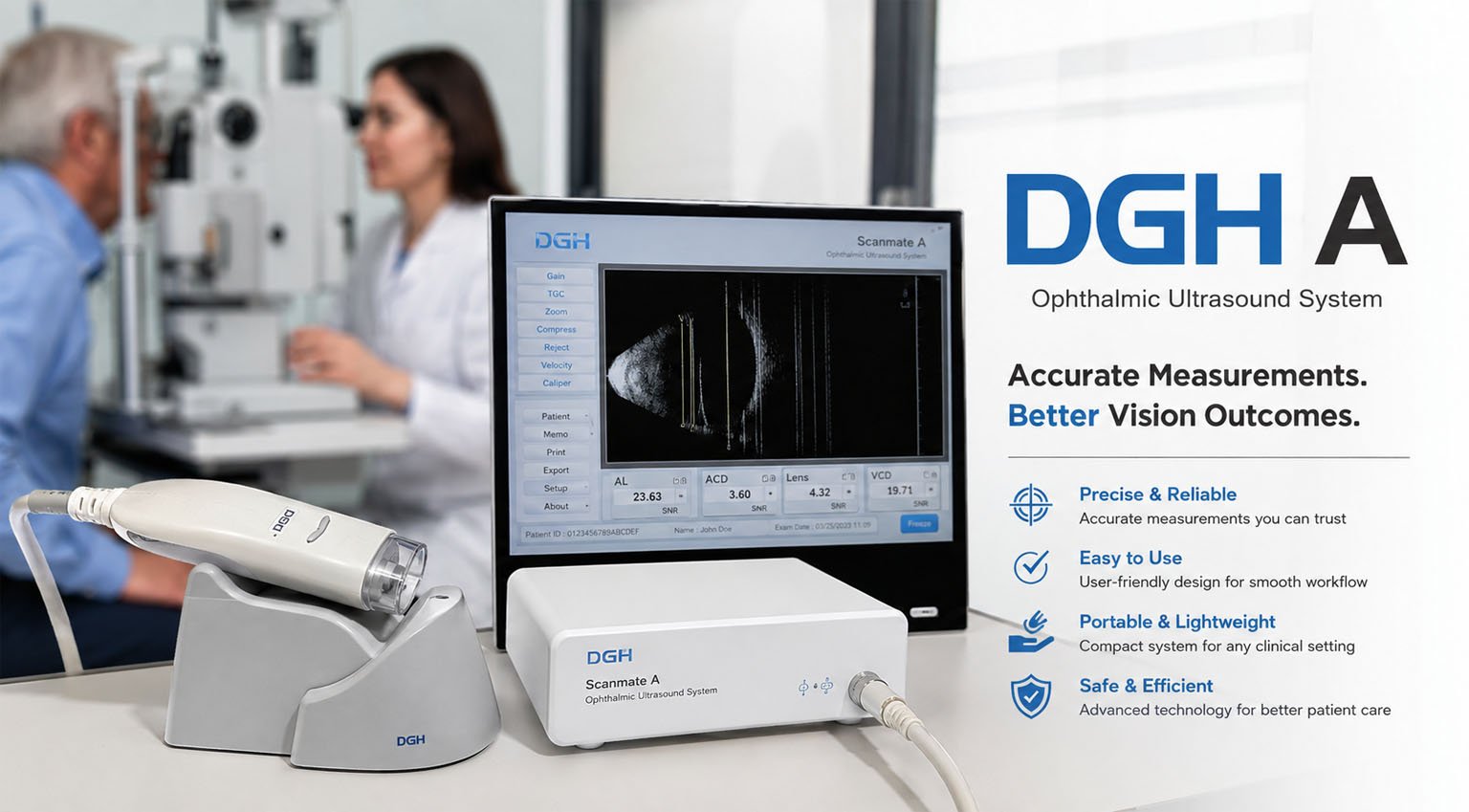
Good eye care starts with clear and correct eye checks. Before an eye doctor plans cataract surgery, they need to know the size and shape of the eye. Even a very tiny mistake in eye measurement can affect how well a person sees after surgery.
This is where DGH A becomes very helpful. DGH A is a smart eye measurement device used by eye doctors. It helps measure the eye with safe sound waves. These measurements help doctors make better choices during eye care and cataract planning.
Many people may hear the name DGH A and think it sounds too technical. But the idea is simple. It is a small tool that helps doctors understand the eye better. It gives useful numbers that are needed before surgery, during check-ups, and while watching eye changes over time.
In this article, we will explain DGH A in very easy words. We will talk about what it is, who makes it, how it works, why eye measurement matters, and how it helps with cataract surgery. We will also look at its main features and why many clinics trust it.
What Is DGH A?
DGH A is also known as Scanmate A. It is an eye ultrasound device. Eye doctors use it to measure important parts inside the eye. It is often called an A-Scan ultrasound device because it uses A-Scan technology.
An A-Scan device sends safe sound waves into the eye. These sound waves bounce back from different parts of the eye. The machine then reads those signals and turns them into useful eye measurements.
DGH A can help measure eye length, also called axial length. It can also help measure lens thickness. These numbers are very important when a doctor needs to plan cataract surgery or study eye growth.
The best thing about DGH A is that it is small, light, and easy to use. It connects to a Windows computer with a USB cable. This makes it useful for large hospitals, small clinics, and even mobile eye camps.
Who Makes DGH A?
DGH A is made by DGH Technology, Inc. This company has worked in eye ultrasound technology since 1982. That means it has many years of experience in making tools for eye doctors.
DGH Technology is based in Pennsylvania, USA. The company is known for making eye care devices that are accurate, simple, and useful in real clinic settings. Its products are made to help doctors save time and give better care.
One important thing about DGH Technology is that its products are made at its own facility in Pennsylvania. This helps the company keep better control over quality. It also helps make sure each device is made with care.
The company focuses on three simple things: good quality, useful design, and fair cost. This is why many eye care workers trust DGH devices. They are made for real doctors who need tools that work well every day.
Why Eye Measurement Matters
Eye measurement is very important in eye care. Before cataract surgery, the doctor needs to choose the right artificial lens for the patient. This lens is called an IOL, which means intraocular lens.
To choose the right lens, the doctor needs correct eye numbers. One of the most important numbers is eye length. This is the distance from the front part of the eye to the back part of the eye.
Even a small difference in this number can change the final result after surgery. For example, if the measurement is wrong, the chosen lens may not match the eye well. This can lead to blurry vision after surgery.
DGH A helps reduce this problem by giving clear and accurate measurements. It helps doctors plan with more confidence. This is very helpful because cataract surgery is one of the most common eye surgeries in the world.
What DGH A Measures
DGH A measures the eye using ultrasound sound waves. One of its main jobs is to measure axial length. This means the full length of the eye from front to back.
It can also measure the natural lens inside the eye. This is called lens thickness. Knowing lens thickness can help doctors understand the eye better before treatment or surgery.
These measurements are helpful for cataract surgery planning. They help the doctor choose the correct lens power. A better lens choice can give the patient a better chance of clear vision after surgery.
DGH A can also help in myopia care. Myopia means short-sightedness. In children, doctors may track eye growth over time. If the eye becomes longer too fast, myopia can get worse. DGH A helps doctors watch these changes.
How DGH A Works
DGH A works in a simple way. First, the doctor connects the device to a Windows computer using a USB cable. Then the doctor opens the software and enters the patient’s details.
After that, the doctor gently places a small probe near the eye. This probe sends safe sound waves into the eye. The sound waves move through the eye and bounce back from different parts.
The device reads these signals and creates measurements. The software then shows the eye length, lens thickness, and other useful details. These results can also be saved, printed, or added to patient records.
The test does not take long. In many cases, it only takes a few minutes. For the patient, the process is usually quick and painless. For the doctor, it gives important information needed for better care.
Main Features of DGH A
DGH A has many features that make it useful for eye doctors. One of the biggest features is its small and light design. The device itself weighs less than one pound, and the full setup is still easy to carry.
It also uses a USB connection. This means the doctor can connect it to a Windows computer without needing a large machine. This makes it easier to use in small clinics and busy eye centers.
Another helpful feature is its star and sound guidance system. The screen can show stars to help the doctor place the probe in the right position. The sound also helps guide the user during the test.
DGH A also has a compression lock feature. If too much pressure is placed on the eye, the device can stop the measurement. This helps protect the patient and also keeps the results more accurate.
Contact Mode and Immersion Mode
DGH A can be used in two main ways. The first way is called contact mode. In this method, the probe gently touches the eye. Doctors may use numbing drops so the patient feels comfortable.
The second way is called immersion mode. In this method, the probe does not press directly on the eye. A small shell and liquid are used to help scan the eye. This method can give very accurate results in many cases.
Both methods are useful. The doctor can choose the best one based on the patient and the situation. Some clinics may use contact mode because it is quick. Others may use immersion mode when they want very careful measurements.
This choice makes DGH A more flexible. It gives eye doctors more control during the test. It also helps them get better results for different types of patients.
DGH A and Cataract Planning
Cataract surgery needs careful planning. A cataract happens when the natural lens inside the eye becomes cloudy. During surgery, the cloudy lens is removed and replaced with a clear artificial lens.
To choose the right artificial lens, the doctor needs correct eye measurements. This is where DGH A is very important. It helps measure the eye length and gives the doctor the numbers needed for lens power calculation.
DGH A includes many trusted IOL formulas. These include SRK/T, Hoffer Q, Haigis, Holladay, and Shammas. These formulas help doctors decide which lens power may work best for the patient.
It can also help with eyes that had LASIK or PRK surgery before. These eyes can be harder to measure. So, having special formulas is very helpful for better cataract planning.
DGH A for Myopia Tracking
DGH A is not only useful for cataract planning. It can also help doctors watch myopia. Myopia means short-sightedness. A person with myopia can see close things clearly, but far things may look blurry.
This is very common in children and young people. In many cases, myopia gets worse when the eye grows too long. That is why doctors need to check eye length over time.
DGH A helps by measuring axial length again and again during follow-up visits. The doctor can compare old and new results. This helps show if the eye is growing too fast or staying stable.
The software can also make growth charts. These charts make it easier to see changes in a simple way. This is very helpful for parents too, because they can understand whether the child’s treatment is working.
Benefits of DGH A for Doctors
DGH A helps doctors save time during eye checks. It is small, light, and easy to move. A doctor can use it in a clinic room, hospital room, training center, or even at a mobile eye camp.
The device also has simple software. This means clinic staff do not need very long training. The screen is clear, the guidance system is helpful, and the reports are easy to read.
Another big benefit is accuracy. Doctors need correct numbers before making treatment choices. DGH A gives repeatable results, which means the same eye can be checked more than once with steady results.
It also helps with record keeping. Results can be saved, printed, or added to patient files. This makes the work smoother for busy clinics that need fast and clean patient reports.
Benefits of DGH A for Patients
For patients, DGH A makes the eye test quick and simple. The test uses safe sound waves. It does not use sharp tools, and it does not take a long time.
Most patients do not feel pain during the test. In contact mode, the doctor may use numbing drops. In immersion mode, the probe does not press directly on the eye, which can feel more comfortable for many people.
Patients also benefit from better surgery planning. When the doctor gets correct eye measurements, it becomes easier to choose the right artificial lens. This can improve the chance of clearer vision after cataract surgery.
DGH A is also useful for children with myopia. Parents can see if the child’s eye growth is changing. This helps doctors plan better care and change treatment when needed.
Simple Technical Details of DGH A
DGH A uses a 10 MHz ultrasound probe. In simple words, this probe sends sound waves into the eye and reads the returning signals. These signals help the software create eye measurements.
The device can measure eye length from 15 mm to 40 mm. This range can work for many patients, including children and adults. It also measures lens thickness from 2 mm to 7.5 mm.
DGH A can show very small details. Its resolution is 0.01 mm. This is helpful because eye surgery planning needs very careful numbers.
The device connects with USB 2.0 and works with Windows computers. It is also known as a portable device because the main unit is small and light. The articles also mention FDA approval and CE certification, which show that it meets trusted safety and quality rules.
DGH A Compared to Other Eye Tools
Some eye ultrasound machines are large and hard to move. They may need more space, more setup time, and more training. This can be difficult for small clinics.
DGH A is different because it is small and easy to carry. It does not need a large machine setup. A clinic can connect it to a Windows computer with a USB cable and start using the software.
Another helpful point is that DGH A has both contact and immersion modes. Some basic devices may not give this choice. Having both modes helps doctors choose the best way to measure each patient.
It also includes useful lens formulas inside the software. This means doctors can measure the eye and plan cataract lens power in the same system. This saves time and keeps the process simple.
Where DGH A Can Be Used
DGH A can be used in many eye care settings. It is useful in private eye clinics where doctors need a small and trusted device for daily checks.
It is also useful in big hospitals. Hospitals often need tools that give fast and accurate results. DGH A can help doctors prepare patients for cataract surgery and other eye care needs.
The device is also a good choice for mobile eye camps. Because it is light and portable, doctors can carry it to rural areas, health camps, and places where large machines may not be easy to use.
Medical schools and training centers can also use it. Students and new eye care staff can learn eye measurement with simple software and clear guidance. This makes learning easier and more practical.
Other DGH Eye Care Devices
DGH Technology also makes other eye care tools. One of them is Scanmate Flex. This is a more advanced system because it can support A-Scan, B-Scan, and UBM.
A-Scan is used for measuring eye length. B-Scan is used to see deeper eye structures. UBM, or ultrasound biomicroscopy, helps show small parts near the front of the eye.
Scanmate Flex also has more mounting choices. It can be used on a desk, mounted on a wall, or placed on a cart. It also has a rechargeable battery, which helps when moving between rooms.
The provided details also mention Pachmate 2 and Pachette 4. These tools help measure corneal thickness. This can be useful for glaucoma checks and other eye care needs.
Eye Problems DGH Devices Can Help With
DGH A is mainly linked with cataract planning and eye length measurement. It helps doctors get the numbers needed before choosing an artificial lens.
Other DGH devices can help with more eye problems too. For example, pachymeters can help with glaucoma checks by measuring corneal thickness. This can help doctors understand eye pressure readings better.
Scanmate Flex can help with retinal detachment checks through B-Scan imaging. It can also help with uveitis and small eye structure checks through UBM.
These tools can support care for cataracts, glaucoma, myopia, retinal problems, uveitis, and keratoconus. They do not replace the doctor’s skill, but they give helpful data for better care.
Things to Know Before Using DGH A
DGH A is simple to use, but it should still be used by trained eye care staff. Correct probe position is very important. If the probe is not placed well, the result may not be as useful.
The star and sound guidance system helps with this. It gives the user signs during the scan. This helps the doctor or trained staff know when the scan is better.
Doctors also need to choose the right mode. Contact mode may be quicker. Immersion mode may be better when very careful measurement is needed. The choice depends on the patient and clinic needs.
The results should always be checked carefully before surgery planning. A device gives numbers, but the eye doctor must read them, compare them, and decide what is best for the patient.
Final Thoughts
DGH A is a helpful eye measurement tool for modern eye care. It is small, simple, and accurate. It helps doctors measure eye length, lens thickness, and other important details with safe ultrasound sound waves.
It is especially useful for cataract planning because correct eye measurements help doctors choose the right artificial lens. This can improve the chance of better vision after surgery.
DGH A also supports myopia tracking, patient reports, and clinic workflow. Its USB connection, simple software, star guidance, sound guidance, contact mode, and immersion mode make it useful for many eye care settings.
In simple words, DGH A helps make eye care easier, faster, and more accurate. For doctors, it gives trusted numbers. For patients, it supports safer checks and better care.
(FAQs)
What is DGH A?
DGH A is an eye ultrasound device also called Scanmate A. Eye doctors use it to measure eye length and lens thickness. These measurements help with cataract surgery planning and eye checks.
What is DGH A used for?
DGH A is mainly used for eye measurement before cataract surgery. It also helps track myopia, check eye growth, and support general eye care planning.
Is DGH A safe?
Yes, DGH A uses safe ultrasound sound waves. It also has a compression lock feature that helps stop wrong readings if too much pressure is placed on the eye.
Is DGH A used for children?
Yes, DGH A can be used for children when a trained eye care professional decides it is needed. It can help track eye growth in children with myopia.
Does DGH A help with cataract surgery?
Yes, DGH A helps doctors measure the eye before cataract surgery. These numbers help choose the right artificial lens for better vision results.
Is DGH A heavy?
No, DGH A is small and light. The main device weighs less than one pound, and the full setup is still easy to carry.
Where is DGH A made?
DGH A is made by DGH Technology, Inc. The company is based in Pennsylvania, USA, and is known for ophthalmic ultrasound devices.
Read next:
TimeWarp TaskUs Made Easy: A Complete Guide for Employees and Teams
