
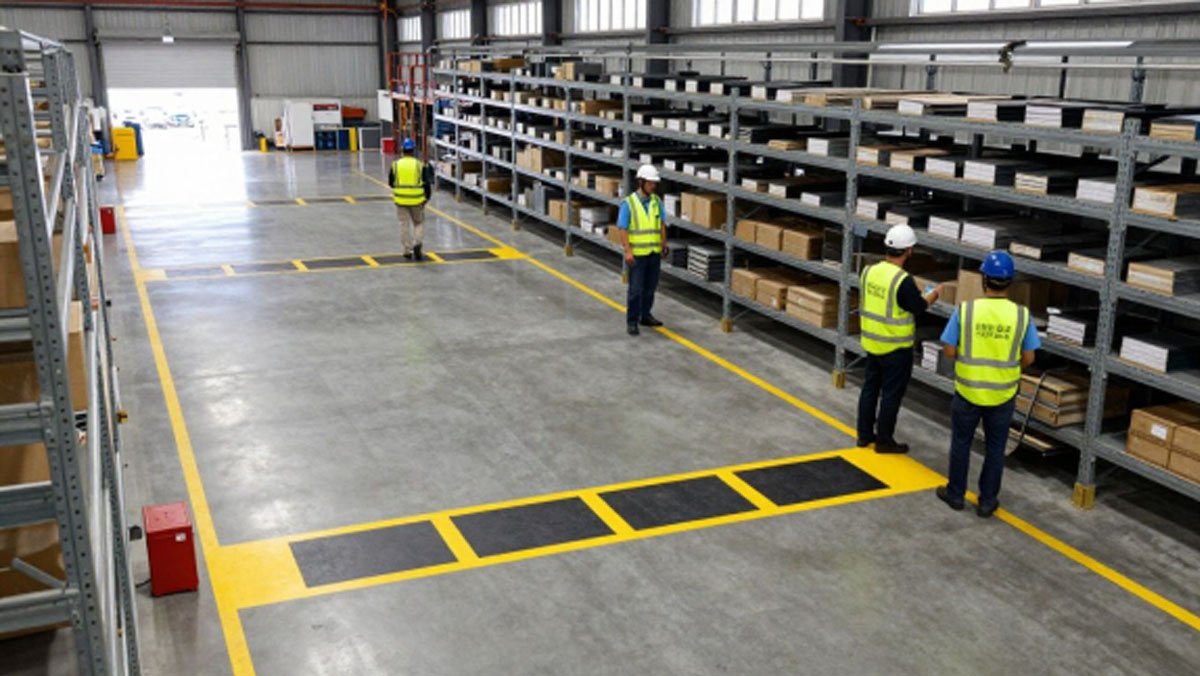
Visual communication is the backbone of a high-performing warehouse environment. By relying on clear visual indicators, facilities can eliminate guesswork and ensure that every employee understands the surroundings. Proper application of warehouse labelling and signage keeps the facility organized while fostering a cohesive operational culture.
Defining standard visual communication systems
Standard systems depend on consistency across the facility to ensure that everyone, from new hires to seasoned team members, can navigate the space intuitively. These systems often include uniform color codes, standardized font styles, and repeatable shapes for specific types of information. By establishing these frameworks early, organizations make it much easier for staff to internalize the meaning of every sign they encounter.
Impact on warehouse operational flow
Operational flow relies on the seamless movement of goods and personnel through designated channels. When signs are positioned correctly, they prevent bottlenecks at busy junctions and clarify the intended path for material handling equipment. Efficiency is maintained because employees no longer have to stop and rethink their route during high-volume periods, as the visual cues guide them naturally and quickly.
Distinguishing between labels and directional signage
While often grouped together, labels and directional signs serve different purposes. Labels typically provide specific identifiers for rack locations or individual storage units to ensure inventory is tracked accurately. Conversely, directional signage acts as a roadmap for the entire building, orienting people toward exit doors, loading docks, or specific departments. Understanding this distinction is essential for maintaining a clean and effective visual hierarchy.
Enhancing workplace safety through clear communication
Safety in a warehouse environment is non-negotiable and requires a proactive approach to risk management. Clear communication through signs helps to warn employees of invisible dangers and keeps traffic patterns predictable. By integrating safety standards directly into the facility design, managers prioritize the well-being of their workforce every single day.
Marking hazardous zones and restricted areas
Restricted areas must be demarcated with high-contrast markings that leave no room for misunderstanding. Whether identifying electrical panels, battery charging stations, or chemical storage, signs provide the critical warning needed to prevent unauthorized access. This practice minimizes errors that could lead to accidents in high-stakes environments.
Adhering to OSHA and safety compliance standards
Compliance is about much more than just avoiding fines; it is about creating a baseline of safety for everyone. Using standardized signs that meet federal requirements ensures that all communication aligns with established safety protocols. Providers like DLSwarehouse offer solutions designed to keep facilities aligned with industry safety expectations for modern distribution centers.
Communicating emergency exit and fire safety information
Emergency exits should always be highlighted clearly to ensure that nobody is confused during a crisis. Fire extinguishers and alarm points need highly visible markers that are visible even from a distance. Maintaining these signs at eye level and ensuring they remain free of obstructions is a critical duty for maintaining a compliant workplace.
Reducing forklift and pedestrian accidents
Separating foot traffic from heavy equipment is one of the most effective ways to reduce forklift and pedestrian accidents within a warehouse. Clear aisle indicators and floor markings define safe walking paths for workers while ensuring that vehicle operators know exactly where they are permitted to travel. This structured approach helps everyone feel more confident and secure during daily operations.
Maximizing warehouse efficiency and speed
Efficiency gains come from minimizing the time required to locate and retrieve stock across a vast facility. When labels are intuitive and well-organized, staff can move through the warehouse with greater speed and focus. This speed ensures that orders are filled accurately and on time, meeting customer expectations consistently.
Streamlining inventory location and retrieval
Inventory retrieval speed is directly proportional to the clarity of your shelving tags. When location coordinates are clearly marked on every rack, workers spend less time searching for items. This simple change allows for faster throughput and more predictable picking cycles throughout the busy workday.
Improving picking accuracy for warehouse staff
Accuracy relies on removing ambiguity from the selection process. When a staff member can easily match a printed document to a physical rack label, errors disappear. Reducing mistakes prevents the need for double-checking, which significantly boosts the overall speed of the packing and shipping department.
Optimizing traffic flow for material handling vehicles
Vehicle operators need reliable guidance to keep the warehouse moving without congestion. By implementing a systematic traffic plan with clear floor markers, warehouses can prevent collisions and maximize the efficiency of material handling equipment in every aisle.
Reducing training time for new employees
New staff members often struggle to learn the layout of a large facility, but signage helps bridge that knowledge gap. When a facility is well-marked, employees spend less time asking for directions and more time performing their core tasks effectively. Clear signage acts as an on-demand training tool that guides team members from their very first day on the floor. Consider these primary ways that effective labeling benefits your staff:
- Reduces the time spent cross-referencing floor maps
- Facilitates easier navigation for temporary or seasonal employees
- Decreases physical walking distance by providing the shortest route
- Improves overall morale through better work environment clarity
After implementing these simple system improvements, leadership often sees a significant decrease in the onboarding time required for new staff members, allowing the entire team to reach peak performance levels much faster than before.
Choosing durable materials for high-traffic environments
Choosing the right material for labels and signs is just as important as the information displayed on them. Environments with heavy equipment and constant foot traffic will quickly destroy cheap or flimsy materials. Investing in high-quality materials ensures the signage remains readable and intact for years without requiring frequent replacement.
Evaluating adhesive technologies for rack surfaces
Adhesives must be carefully selected based on the surface texture of the racks, such as powder-coated metal or galvanized steel. Using industrial-grade bonding techniques ensures that labels won’t peel or flake away over time in a cold or humid climate. A secure bond is the foundation of long-term label stability.
Selecting weather-resistant materials for loading docks
Loading docks are often exposed to extreme changes in temperature and humidity, which can quickly degrade standard paper or adhesive materials. Opting for weather-resistant signage made from reinforced plastic or treated metal provides the longevity needed for exterior or threshold areas. Such durability prevents fading and preserves crucial safety messages throughout the changing seasons.
Assessing scratch-proof and impact-resistant coatings
Physical impacts from pallets or vehicle forks are common in tight warehouse aisles, so signage should be shielded accordingly. Scratch-proof coatings provide a protective layer that keeps the printing sharp even if a sign is bumped or brushed against. These resilient materials serve as the first line of defense against the daily wear and tear of a bustling facility.
Considering color-coding standards for long-term readability
Maintaining color-coding schemes requires durable ink that resists UV light and chemicals. Over time, labels can become discolored, leading to confusion, so choosing UV-resistant materials is a smart long-term strategy. The following table highlights common material types and their ideal applications for maximum durability in various warehouse zones.
| Material Type | Primary Usage | Key Benefit |
| Reinforced Vinyl | Floor and Traffic Lanes | High abrasion resistance |
| Anodized Aluminum | Loading Docks | Weather and rust protection |
| Polycarbonate Overlays | High-Collision Racks | Maximum impact protection |
Selecting these durable options minimizes maintenance cycles, saving the facility significant time and money on replacement tasks while keeping the warehouse floor looking uniform and professional for the long haul.
Strategic placement and hierarchy of information
Information is only effective if it can be seen at the right moment and from the right angle. Understanding how to manage the visual hierarchy allows you to guide workers through the facility with minimal effort. Strategically placing your signs transforms a chaotic space into a well-ordered system that works for everyone.
Identifying high-visibility zones for directional signage
Visibility is key to directing traffic flow through complex intersections or large aisles. Signs placed at overhead junctions or end-of-aisle positions naturally capture the attention of fork-lift drivers and foot traffic alike. Identifying these zones depends on observing where natural bottlenecks occur and placing the information exactly where someone might hesitate.
Calculating the effective viewing distance for hanging signs
Effective viewing distance depends on the size of the text and the mounting height of the signage. A hanging sign intended for forklift operators sitting high up will require larger font sizes than a label meant for a picker standing right in front of a rack. Planning these dimensions ensures that the message is legible from the intended distance.
Organizing rack labeling by shelf level and pallet orientation
Shelf identifiers should follow a logical sequence that corresponds to your warehouse management system. When labels are organized consistently—perhaps using alphanumeric sequences—it prevents errors in inventory tracking. Aligning the physical labels with the digital layout is a foundational step in warehouse optimization.
Implementing floor marking systems for layout navigation
Floor markings are indispensable for keeping complex warehouse layouts organized. By using colored tapes or painted lines, you can designate specific pathways for different types of movement, which reduces the risk of accidents. These lines provide constant, low-level guidance that keeps warehouse traffic orderly without needing any extra signage height.
Implementing smart labeling technologies
Modern warehouses are moving toward dynamic systems that provide real-time updates to staff on the ground. Smart technology integration, such as barcode systems and RFID, allows for near-perfect inventory tracking that traditional signs cannot match alone. By connecting physical signage to your digital database, you ensure that every part of the facility stays synchronized.
Integrating barcode technology for WMS compatibility
Barcode systems remain the standard for precise data collection within a warehouse. By ensuring that your rack labels are compatible with handheld barcode scanners, you facilitate lightning-fast inventory updates that integrate directly into your management software. This digital link is essential for maintaining accurate records and optimizing workflows.
Utilizing RFID tags for automated tracking
RFID technology takes inventory visibility to the next level by allowing for non-line-of-sight tracking. These tags enable staff to monitor inventory moving through zones without the need for manual scanning intervention. This automation reduces human error and liberates employees to focus on more complex, value-added tasks.
Exploring digital displays for dynamic workforce instructions
Digital displays offer the unique advantage of providing information that changes based on real-time task needs. Instead of static signs, digital screens can cycle through instructions for the current shift or highlight high-priority picking orders at key junctures. This flexibility helps the workforce adapt to shifting priorities during the busy day.
Maintaining and auditing signage systems for ongoing accuracy
Even the best signage systems will degrade over time without a regular audit schedule. Managers should perform periodic checks to ensure that all labels remain legible and that directional signs reflect the current floor layout. consistent auditing ensures that your warehouse labelling and signage remain effective, compliant, and accurate for your entire team.
Conclusion
Investing in proper warehouse labelling and signage is about creating a safer, more efficient space that empowers every member of your team. By combining clear visual communication, durable physical materials, and modern smart technology, you lay the groundwork for better performance and streamlined operations. Taking the time to curate these systems today will serve as a foundation for growth and organizational success in your facility for years to come.
